
Double vs. Triple-Pane Windows in Texas: Are They Worth It?
By Paul Armstrong | Nov. 23, 2026 | 14 min. read
When shopping for replacement windows in Texas, you may come across both double-pane and triple-pane options. But is paying more for an extra pane of glass actually worth it? Or will you regret choosing double-pane windows if your home is still uncomfortable?
The last thing you want is to spend thousands more on an upgrade you don’t need, or save money upfront only to discover your new windows aren’t solving the problem.
Since 1988, Allied Exteriors has helped homeowners throughout Houston, Dallas–Fort Worth, and Austin understand what they’re actually paying for when replacing their windows. That means looking beyond the number of glass panes to compare Low-E coatings, energy performance ratings, window construction, and factors like afternoon sun exposure.
To help answer these questions, we spoke with Paul Armstrong, an Allied Exteriors Exterior Advisor with 40 years of residential construction experience. As an experienced window and door installer-trainer, Paul understands how windows perform as part of the entire home, not just how they compare on paper. His perspective helps homeowners understand which upgrades are worth paying for and which may offer little practical benefit.
In this article, we’ll break down the differences between double-pane and triple-pane windows, where each performs best, and whether the additional cost of triple-pane glass is justified in Texas. Our goal is to help you choose the right window without paying for performance you don’t need.
Table of Contents (Click to Expand)
What Is the Difference Between Double-Pane and Triple-Pane Windows?
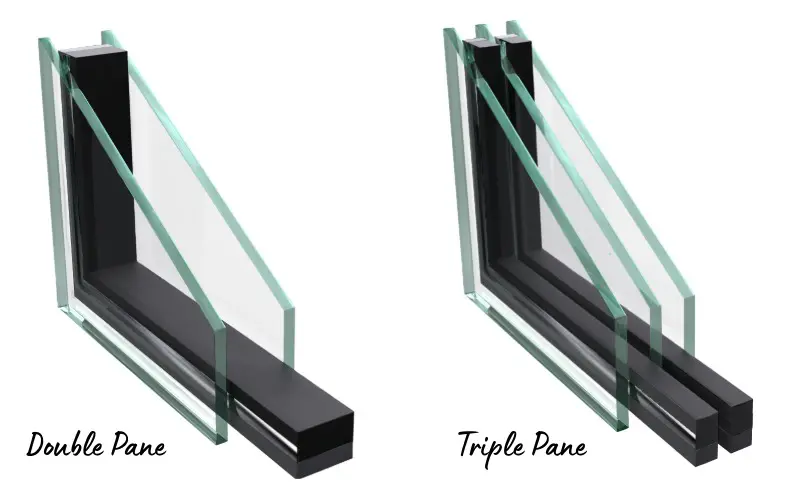
The biggest difference is exactly what it sounds like: double-pane windows have two layers of glass, while triple-pane windows have three.
Both use sealed insulating spaces between the glass panes, which may contain air or an insulating gas such as argon to help slow heat transfer.
| Feature | Double-Pane Windows | Triple-Pane Windows |
|---|---|---|
| Glass layers | 2 | 3 |
| Insulating spaces | 1 | 2 |
| Thermal insulation | Very good with appropriate glass | Generally better with comparable specifications |
| Noise reduction | Good, depending on glass package | May provide additional reduction |
| Weight | Lighter | Heavier |
| Cost | Standard double hung installed – $800-$2,500 | 10%-40% more |
| Best suited for | Most Texas homes | Specific performance or comfort priorities |
More glass doesn’t automatically mean better performance for your home. Low-E coatings, insulating gas, glass thickness, and overall window construction all influence the results.
Are Triple-Pane Windows More Energy-Efficient in Texas?
Yes. Triple-pane windows can provide better insulation than comparable double-pane windows, but how much that matters depends on the climate and the specific glass package.
In colder parts of the country, such as the Midwest and Northeast, triple-pane windows can be particularly beneficial because their additional insulation helps reduce heat loss during winter.
However, better insulation doesn’t translate directly into the same percentage of energy savings on your utility bill. The actual benefit depends on the window’s performance ratings, your climate, and the conditions in your home.
Texas presents a different challenge. For much of the year, homeowners in Houston, Dallas, and Austin are more concerned about keeping outdoor heat from entering their homes.
That means controlling solar heat gain can be just as important as improving insulation. Fortunately, there are two window performance ratings that can help you understand how well a window does both.
What Are U-Factor and Solar Heat Gain Coefficient?
When comparing energy-efficient windows, there are two ratings worth understanding.
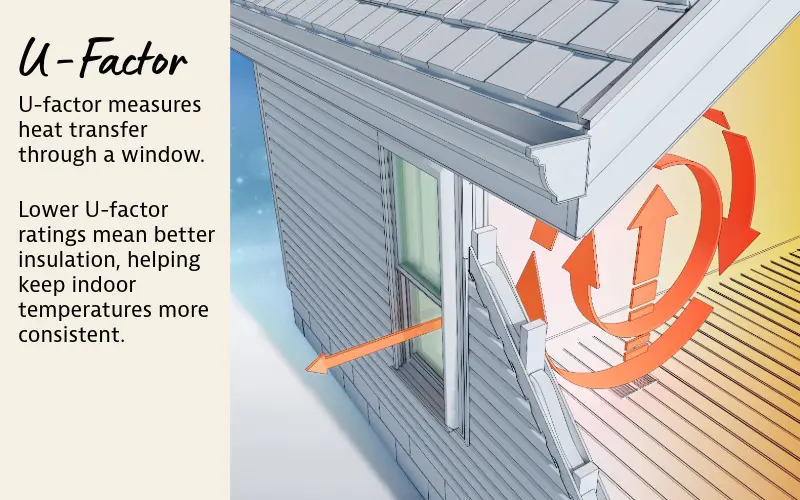
U-Factor measures how easily heat passes through the entire window. A lower number means better insulation.
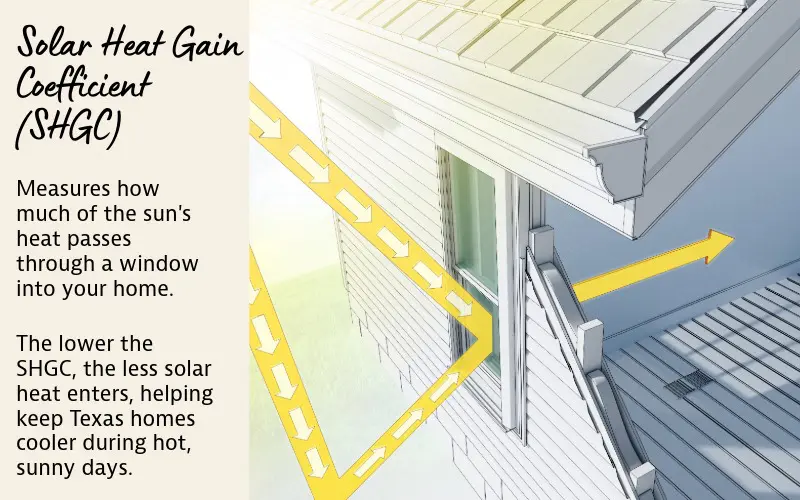
Solar Heat Gain Coefficient (SHGC) measures how much solar heat enters through the window. A lower number means less heat from sunlight enters your home.
For example, imagine comparing a double-pane window with a high-performance Low-E coating against a triple-pane window with a less suitable solar-control package.
Even though the triple-pane window has more glass, the double-pane option could provide better solar heat control.
This is why we recommend comparing actual window performance ratings rather than assuming more panes automatically mean better results.
How Important Is Low-E Glass in Texas?
Low-E glass is especially important in Texas because it helps reduce the amount of heat entering your home through your windows while still allowing natural light inside.
Low-E stands for low-emissivity. It’s a thin, nearly invisible coating applied to glass that helps control radiant heat transfer.
For Texas homeowners, the right Low-E coating can help:
- Keep rooms cooler: Reduce solar heat entering through windows, especially in rooms exposed to direct afternoon sunlight.
- Reduce cooling demand: Limit unwanted heat gain so your air conditioning system doesn’t have to work as hard.
- Protect interior furnishings: Reduce the amount of ultraviolet (UV) radiation passing through the glass, which can contribute to fading.
However, not all Low-E coatings perform the same way. Some prioritize retaining indoor heat, while others are designed to reduce solar heat gain.
During our interview, Allied Exterior Advisor Paul Armstrong discussed how differences in Low-E coatings, insulating glass thickness, and gas fills can affect window performance.
For most Texas homeowners, choosing a double-pane window with the right solar-control Low-E coating may be more beneficial than simply adding a third pane of glass. That’s why it’s important to compare the actual U-factor and SHGC ratings of the windows you’re considering.
How Much More Do Triple-Pane Windows Cost in Texas?
Triple-pane windows can cost approximately 10%–40% more than comparable double-pane windows, according to published industry estimates. This range refers to the window product cost, not necessarily the total installed project price. The actual premium depends on the manufacturer, window size, frame material, and glass package.
A third pane adds material and manufacturing costs, and the heavier glass unit may require different window components. Not every manufacturer offers triple-pane glass in every window style or size, either.
The additional cost can become especially noticeable when you’re replacing an entire home’s windows. However, rather than relying on a general percentage, we recommend comparing the actual price of two windows with similar specifications.
Why Are Triple-Pane Windows More Expensive?
Several factors can affect the price difference:
- Additional glass and materials: A third pane requires more glass, spacers, and sealing components.
- Window construction: The added weight may require compatible frames, balances, or hardware.
- Product availability: Triple-pane options may be limited to certain manufacturers, styles, or sizes.
- Installation considerations: Larger or heavier windows may require additional handling.
The important question isn’t simply how much more triple-pane windows cost. It’s what you’re getting for that additional investment.
Will Triple-Pane Windows Save Enough Energy to Justify the Cost?
Triple-pane windows can provide additional insulation, but whether the energy savings justify their higher price depends on the specific windows and your home.
In Texas, a quality double-pane window with the right Low-E coating can already provide excellent energy performance. While upgrading to triple-pane glass may improve insulation further, that doesn’t necessarily translate into significant savings on your heating and cooling bills.
Without comparing the actual upgrade cost and expected energy savings, there’s no reliable way to determine how long it would take to recover the additional investment.
Here’s what you should consider when comparing two window quotes besides overall price:
| What to compare | Why it matters |
|---|---|
| Total installed price | Shows how much more you’ll pay for the entire project |
| Glass upgrade cost | Isolates the additional expense of triple-pane glass |
| U-Factor | Shows how much insulation improves |
| SHGC | Shows how effectively each window limits solar heat gain |
| Other glass features | Identifies differences in Low-E coatings, gas fills, and sound-control options |
For a broader breakdown of replacement window pricing, read our guide to how much replacement windows cost in Texas.
Which Windows Are Better for Texas Heat, Noise, and Comfort?
The right glass package depends on the problem you’re trying to solve. Triple-pane windows can offer additional insulation, but that doesn’t necessarily make them better for every Texas home.
Which Windows Are Better for Hot, Sun-Exposed Rooms?
If you have a room that becomes unbearably hot every afternoon, it’s easy to assume your windows aren’t insulated well enough. But the problem may have more to do with direct sunlight than the number of glass panes.
West-facing windows receive intense afternoon sun, which can significantly increase the amount of heat entering a room.
In this situation, a window’s Solar Heat Gain Coefficient (SHGC) may matter more than whether it has two or three panes. A quality double-pane window with the right Low-E coating can already do an excellent job of limiting solar heat gain.
Exterior shading, improved insulation, and addressing HVAC issues may also help. Adding a third pane won’t automatically solve an overheated room.
Does Window Performance Differ Between Houston, Dallas, and Austin?
Although all three markets experience hot summers, their climates aren’t identical.
| Texas Market | Common Climate Concerns | Window Considerations |
|---|---|---|
| Houston | Heat, humidity, long cooling season | Solar heat control, proper sealing, moisture management |
| Dallas–Fort Worth | Hot summers, colder winter periods, temperature swings | Balance between solar control and insulation |
| Austin | Long cooling season, intense summer sun | Low SHGC, Low-E performance, sun exposure |
While Dallas–Fort Worth generally experiences colder winter conditions than Houston or Austin, that doesn’t automatically make triple-pane windows the better investment.
Across all three markets, the home’s specific conditions matter more than the city alone. A west-facing room with intense afternoon sun may benefit more from improved solar-control glass, while a homeowner concerned about winter comfort may place greater value on additional insulation.
Are Triple-Pane Windows Better at Reducing Outside Noise?
Sometimes, but the number of panes alone doesn’t tell you how quiet a window will be.
Sound reduction depends on several factors:
- Glass thickness: Different glass thicknesses can help reduce certain sound frequencies.
- Insulating space: The distance between panes influences sound transmission.
- Laminated glass: A special interlayer can improve noise reduction.
- Window installation and home construction: Window frames, seals, and installation gaps can allow outside noise to enter. However, noise can also travel through poorly insulated walls and other areas of the home, meaning new windows alone may not solve every noise issue.
Paul shared a practical example from his experience helping homeowners concerned about outside noise. For properties near busy streets or with little surrounding tree coverage, he’s discussed recommending a thicker, one-inch insulated glass package rather than a thinner configuration.
He also recalled positive feedback from homeowners who selected thicker glass packages. While he didn’t provide specific before-and-after noise measurements, his experience illustrates an important point: Improving sound performance doesn’t always require adding a third pane of glass.
If noise is your biggest concern, ask your contractor about the window’s Sound Transmission Class (STC) and Outdoor-Indoor Transmission Class (OITC) ratings. These provide a more useful comparison than pane count alone.
Does the Additional Weight of Triple-Pane Glass Matter?
Triple-pane windows are generally heavier than comparable double-pane windows, which can affect available window sizes, styles, and hardware configurations.
For larger windows, the additional glass weight may require different frame components or limit which configurations a manufacturer can offer. This doesn’t mean triple-pane windows are necessarily difficult to install, but it’s another reason to confirm product specifications before choosing the upgrade.
When Are Triple-Pane Windows Worth the Upgrade in Texas?
For most Texas homeowners, double-pane windows offer the better balance of energy efficiency, comfort, and cost. However, there are situations where the additional insulation of triple-pane glass may justify the investment.
3 Situations Where Triple-Pane Windows May Be Worth It in Texas
- You’re building or renovating a high-performance home. If maximizing insulation is a major goal, triple-pane windows may help you meet more demanding energy-efficiency targets.
- Winter comfort is a priority. Triple-pane windows can help keep interior glass surfaces warmer during cold weather, potentially making rooms with large windows more comfortable.
- You value maximum insulation over a quick financial return. If you’re planning to stay in your home long-term and are comfortable paying more for incremental performance improvements, triple-pane glass may be worth considering.
When Is Double-Pane Glass the Smarter Investment?
If your biggest concerns are Texas summer heat, energy bills, and overall project cost, a quality double-pane window with the right Low-E coating is usually the more practical choice.
Rather than paying for a third pane, your money may be better spent on:
- Better solar-control glass to reduce heat entering sun-exposed rooms.
- Improved sound-control glass if traffic or neighborhood noise is a concern.
- Quality frames and weatherstripping to improve overall window performance.
- Proper installation to address air leakage, flashing, and sealing around the window opening.
Even a high-performance triple-pane window can underperform if it’s installed incorrectly. Gaps around the frame can allow conditioned air to escape, while improper flashing can create opportunities for water intrusion.
The goal isn’t to buy the window with the most features. It’s to invest in the features that will make a meaningful difference in your home.
How Should Texas Homeowners Compare Double-Pane and Triple-Pane Proposals?
Before deciding whether triple-pane glass is worth the additional investment, identify what you’re trying to improve.
One of the easiest ways to compare window performance is to look at the NFRC ratings for each window you’re considering. These ratings give you a consistent way to compare energy performance, regardless of the window brand or number of glass panes.
The example label below shows where to find the U-factor and SHGC ratings we discussed earlier. When comparing proposals, ask each contractor for the ratings of the specific windows and glass packages they’re recommending.
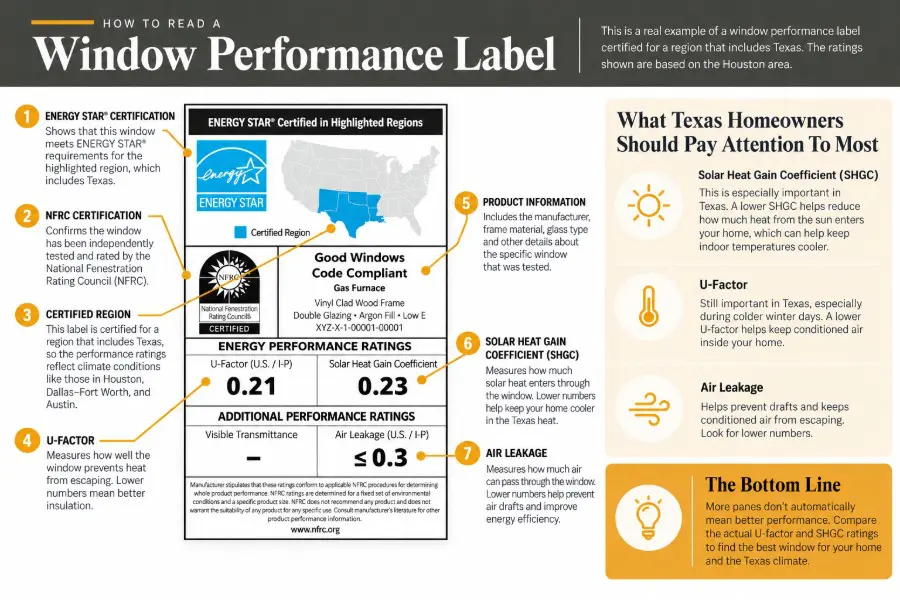
The best window isn’t necessarily the one with the most panes. It’s the one that addresses your concerns at a price that makes sense.
| Your Main Concern | What to Prioritize | When Triple-Pane May Be Worth Considering |
|---|---|---|
| High cooling bills | Low SHGC, appropriate Low-E glass, whole-window performance | When a specific triple-pane package demonstrates meaningful additional benefits |
| Hot afternoon rooms | Solar-control glass, shading, air sealing | If additional insulation is also needed |
| Traffic or neighborhood noise | STC/OITC ratings, laminated or acoustic glass | When tested acoustic performance supports the upgrade |
| Cold rooms near windows | Lower U-factor, proper installation | When additional winter comfort is a priority |
| Maximum energy efficiency | Whole-window U-factor and SHGC | For high-performance homes with demanding efficiency goals |
| Lowest reasonable project cost | Quality double-pane glass and installation | Usually not necessary |
When reviewing two proposals, ask your contractor:
- What are the U-factor and SHGC ratings for each window?
- What Low-E coatings and gas fills are included?
- How much more will triple-pane glass cost for my project?
- What specific benefit should I expect from that upgrade?
- Are there other glass packages that could accomplish the same goal?
- Will the upgrade affect window sizes, styles, or warranty coverage?
A knowledgeable contractor should be able to explain why a particular glass package makes sense for your home, not simply recommend the most expensive option.
Are Triple-Pane Windows Worth It in Texas?
For most Texas homeowners, a quality double-pane window with the right Low-E glass is the smarter investment. Triple-pane windows offer additional insulation, but that doesn’t automatically translate into enough energy savings or comfort improvements to justify the higher cost.
Before paying for an upgrade, identify the problem you’re trying to solve and compare the actual window specifications. At Allied Exteriors, we help homeowners in Houston, Dallas–Fort Worth, and Austin understand their options so they can make informed decisions without paying for features they don’t need.
Your next step: visit our replacement window pricing page to learn how glass packages, window materials, and installation conditions affect your overall investment.
Allied Exteriors Blog
Whether you’re comparing replacement windows, researching siding materials, or trying to understand project costs, our Learning Center is built to help you make informed decisions before talking with a contractor.