

How to Make Better Home Improvement Decisions with ChatGPT
By Ryan Shutt | Sep. 18, 2026 | 23 min. read
Executive Summary: Yes, ChatGPT can help you compare home improvement proposals by organizing pricing, warranties, installation details, financing, and product differences. It cannot evaluate contractor honesty, workmanship, or communication. In this article you’ll learn exactly how to use ChatGPT throughout the buying process, the prompts to use, and why AI should never replace your own judgment.
You’ve done the hard part.
You’ve researched contractors, sat through sales presentations, and now you have several proposals sitting on your kitchen table.
The challenge?
They all look different.
One proposal recommends premium windows with a lifetime warranty. Another offers a similar-looking product for thousands less. Every contractor says they’re the best, and comparing everything side by side can quickly become overwhelming.
What if you had a tool that could read every proposal, explain the differences in simple terms, and help you ask smarter questions before signing a contract?
Recently, one of our Allied customers did exactly that. Instead of calling another contractor for advice, they uploaded their window replacement proposals into ChatGPT and asked it to compare the products, warranties, installation details, financing, and overall value.
The result surprised us, and not because ChatGPT recommended our proposal, but because it revealed something bigger: homeowners now have a powerful way to better understand and compare home improvement quotes.
At Allied Exteriors, we’ve reviewed thousands of proposals over the years, and we know how difficult it can be to compare contractors when every company presents information differently. While AI should never replace your own judgment, it can help you organize information, identify important differences, and feel more confident about your decision.
In this guide, you’ll learn how to use ChatGPT to compare home improvement proposals, what documents to upload, the prompts that produce the best results, where AI falls short, and how to use it as a research assistant throughout your home improvement journey.
By the end, you’ll know how to use AI as a research assistant (not a decision maker) so you can compare proposals with greater confidence and choose the contractor that’s the best fit for your home.
Why Is It So Hard to Compare Home Improvement Proposals?
Whether you’re replacing your windows, installing new siding, or remodeling your kitchen, comparing proposals is rarely as simple as comparing prices.
Every contractor has their own way of presenting information. One proposal might be twenty pages long with detailed product specifications, while another is only a few pages with very little explanation. Some companies include installation details, warranties, and financing information upfront, while others discuss those items verbally during the appointment.
To make matters even more confusing, two proposals that look completely different may actually be offering very similar products. In fact, in the window industry, it’s not uncommon for the same window to be sold under different product names depending on the company quoting it.
For many homeowners, it can feel like you’re trying to compare apples to oranges.
Some of the biggest differences between proposals include:
- Different product brands and model lines
- Different warranty coverage
- Different installation methods
- Different financing options
- Different levels of detail
- Different pricing structures
When every contractor explains things differently, it becomes difficult to know whether you’re comparing better products, or simply better presentations.
Why Are Homeowners Using ChatGPT to Compare Contractor Quotes?
As AI tools like ChatGPT become more common, homeowners are beginning to use them in ways many contractors never expected.
Instead of trying to decipher pages of technical specifications and legal language on their own, they’re uploading their proposals and asking ChatGPT to explain the differences in simple terms.
In many cases, ChatGPT can quickly organize information that would otherwise take hours to compare manually.
It can help homeowners:
- Summarize lengthy proposals
- Compare products side by side
- Explain warranty language
- Highlight differences between contractors
- Identify information that may be missing
- Suggest additional questions to ask before signing
For homeowners who feel overwhelmed by multiple proposals, AI can act like an organized research assistant helping make complicated documents much easier to understand.
Can ChatGPT Actually Tell You Which Proposal Is Better?
Yes, but only to a point. One of the biggest misconceptions about AI is that it can tell you which contractor to hire.
That’s not really its job.
Instead, ChatGPT excels at analyzing written information.
It can compare warranties, summarize financing terms, point out missing details, and explain technical language much faster than most homeowners could on their own.
What it can’t do is evaluate the things that often matter just as much.
For example, ChatGPT can’t tell you:
- Whether a salesperson was honest and transparent
- How professional an installation crew will be
- If a company communicates well during a project
- Whether you’ll enjoy working with that contractor
- How a company handles problems when something goes wrong
As Ryan Shutt, CEO of Allied Exteriors, puts it:
“AI isn’t in the room during the consultation.”
It can’t read body language. It can’t judge character. It can’t tell whether a representative made promises that don’t actually appear in the written contract.
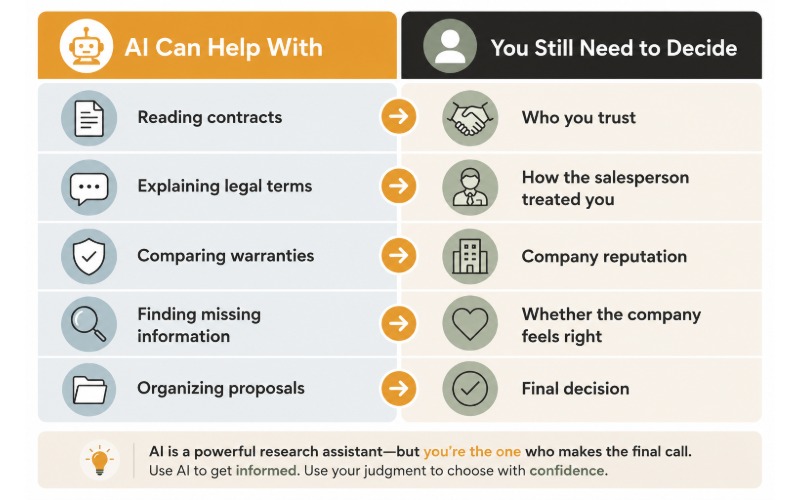
That’s why we recommend thinking of ChatGPT as a research assistant, NOT a decision maker.
The best decisions happen when you combine AI’s ability to analyze documents with your own conversations, instincts, and research about the companies you’re considering.
Key Takeaway
ChatGPT can analyze proposals, contracts, photos, warranties, and other information you provide it. What it can’t do is sit through your consultation or experience the contractor relationship for you.
Use AI to understand your options and ask better questions, but rely on your own judgment to make the final decision.
How Can You Use ChatGPT to Compare Home Improvement Quotes?
The good news is that you don’t need to be an AI expert to use ChatGPT effectively.
If you can upload a PDF or take a photo with your phone, you already have everything you need.
The key isn’t learning complicated prompts. It’s giving ChatGPT the right context, clearly explaining your priorities, providing complete information, and asking thoughtful follow-up questions.
Here’s the process we recommend.
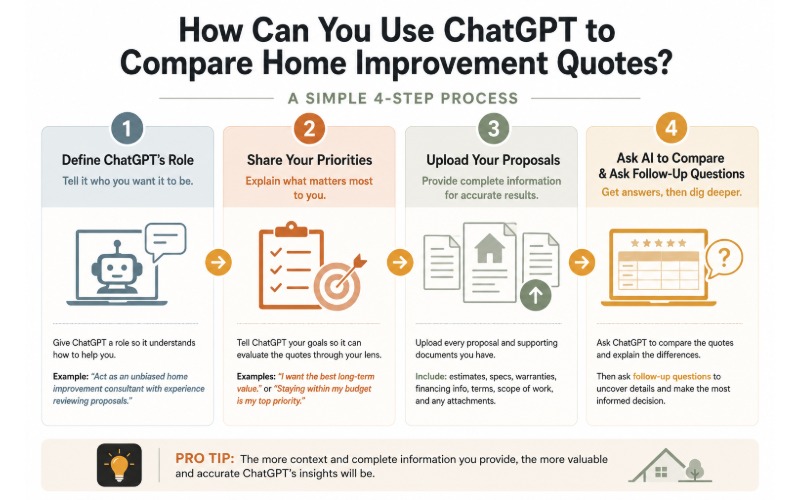
Step 1: Tell ChatGPT What Role You Want It to Play
One of the easiest ways to get better responses is to give ChatGPT a clear role before you ask your question.
Instead of treating it like a search engine, think of it as someone you’re hiring to help review your proposals.
For example, you might ask it to act as:
- An unbiased home improvement consultant
- A replacement window expert
- A contractor who reviews proposals for homeowners
- A consumer advocate helping you compare quotes
Giving ChatGPT a specific role typically leads to much more thoughtful and organized responses.
Copy and Paste Prompt:
Act as an unbiased home improvement consultant with experience reviewing replacement window proposals. Your job is to help me understand the differences between these quotes, explain technical language in simple terms, and identify questions I should ask before making my decision.
New to ChatGPT? Create a free account before uploading your proposals.
Step 2: Tell ChatGPT What Matters Most to You
Before uploading your proposals, explain what you’re hoping to accomplish.
One homeowner may simply want the lowest upfront cost. Another may care much more about warranty coverage or long-term value.
Neither answer is wrong.
The important thing is helping ChatGPT understand how you’ll be making your decision.
For example, you might tell it:
- I want the best long-term value.
- Staying within my budget is my highest priority.
- I plan to stay in this home for the next 20 years.
- I’m most concerned about energy efficiency.
- I want the lowest maintenance option available.
The more context you provide, the more personalized ChatGPT’s recommendations become.
Step 3: Upload Every Proposal You’re Considering
Now it’s time to give ChatGPT the information it needs.
Instead of uploading only the pricing page, upload the entire proposal from each contractor whenever possible.
That includes:
- Proposal or estimate
- Product specifications
- Warranty documents
- Terms and conditions
- Financing information
- Scope of work
- Additional attachments the contractor provided
- Notes you took during the consultation
The more complete the information, the more accurate ChatGPT’s comparison will be.
If one contractor provides a detailed 20-page proposal and another only leaves a one-page estimate, upload both anyway.
In fact, ChatGPT may point out that the lack of detail is something you should ask about before signing. If a contractor isn’t willing to provide important information such as product specifications, warranty details, financing terms, or a clear scope of work before you sign a contract, that should give you pause.
A good contractor should be willing to answer your questions and give you the information you need to make an informed decision. You should never feel pressured to sign a contract before you’ve had the opportunity to understand and compare your options.
Pro Tip: Save each proposal as a PDF whenever possible. If you only have paper copies, clear photos work too, just make sure every page is easy to read.
Step 4: Ask ChatGPT to Compare the Proposals
Once ChatGPT understands its role, your priorities, and has all of your documents, it’s ready to begin comparing them.
Rather than asking:
“Which quote is better?”
Give it a specific objective.
Don’t stop after ChatGPT gives you its first answer. The real value comes from continuing the conversation.
Asking ChatGPT to explain why it reached its conclusions is just as important as the comparison itself. Understanding the reasoning behind its recommendations will help you make a more informed decision.
Copy and Paste Prompt:
Compare the attached proposals based on:
- Product quality
- Scope of work
- Warranty coverage
- Financing terms
- Installation details
- Potential red flags
- Overall long-term value
Create a side-by-side comparison table and explain why you reached your conclusions. Then tell me what additional questions I should ask each contractor before making my decision.
What 5 Things Should ChatGPT Compare in Every Proposal?
One of the biggest advantages of using ChatGPT isn’t simply that it can compare proposals.
It’s that it can compare the right things.
Many homeowners naturally focus on one number, the total price. While price is certainly important, it’s only one piece of the puzzle.
A proposal that’s $4,000 less expensive today could end up costing more over time if it includes lower-quality materials, a weaker warranty, or an incomplete scope of work.
Instead of asking ChatGPT, “Which quote is cheaper?”, ask it to help you understand why the quotes are different.
Here are the areas worth comparing.
1. Are the Products Actually Comparable?
Two window proposals may both say “replacement windows,” but that doesn’t necessarily mean you’re getting the same product.
The same goes for siding, roofing, doors, and nearly every other home improvement project.
Ask ChatGPT to compare things like:
- Manufacturer
- Product line
- Energy efficiency ratings
- Glass packages
- Frame materials
- Optional upgrades
- Included accessories
Sometimes the higher-priced proposal truly includes a premium product. Other times, the products are nearly identical, and you’re paying more for something else.
Understanding those differences is one of the fastest ways to determine whether you’re making an apples-to-apples comparison.
Copy and Paste Prompt:
Compare the products included in these proposals.
Tell me whether they are comparable, what the major differences are, and whether one product appears to provide better long-term value.
2. Does Each Proposal Include the Same Scope of Work?
This is one of the easiest places for homeowners to accidentally overlook important differences.
One contractor may include:
- Removing old materials
- Exterior trim replacement
- Insulation
- Disposal
- Cleanup
- Permits
Another may assume those items are additional charges later.
At first glance, the proposals may look similar. In reality, one contractor could be including significantly more work.
A lower price doesn’t always mean you’re getting a better deal—it may simply mean less work is included.
Copy and Paste Prompt:
Compare the scope of work in each proposal.
Tell me:
-
What work is included by each contractor
-
What work appears to be missing
-
Any assumptions each contractor may be making
-
Questions I should ask before signing.
3. What Does the Warranty Actually Cover?
Warranties often sound much better during the sales presentation than they read on paper.
That’s usually because warranties are written by attorneys, not homeowners.
Terms like “lifetime warranty” can mean very different things depending on the company.
For example:
- Does lifetime mean your lifetime?
- The lifetime of the product?
- Is labor included?
- Is glass breakage covered?
- Is the warranty transferable?
- What maintenance are you responsible for to keep the warranty valid?
Those details matter.
ChatGPT does an excellent job translating complicated legal language into plain English, making it much easier to understand what you’re actually getting.
Take notes during every consultation. Then compare what the salesperson told you against the written contract. If those two things don’t match, that’s a conversation worth having before you sign.
Copy and Paste Prompt:
Explain this warranty in simple terms.
Tell me:
-
What is covered
-
What isn’t covered
-
What responsibilities I have as the homeowner
-
Any maintenance requirements
-
Anything that seems unusually restrictive or confusing.
4. Are the Installation Methods the Same?
When homeowners compare proposals, they often spend most of their time looking at the window, siding, or roofing product itself.
But here’s something many people don’t realize:
The installation can have just as much impact on the long-term performance of your project as the product you’re buying.
A high-quality window that’s installed incorrectly may not perform as intended. Likewise, premium siding or roofing materials can’t compensate for poor workmanship.
That’s why ChatGPT can be so helpful when comparing the scope of installation, not just the products.
As you review proposals, ask ChatGPT to compare things like:
- How the existing materials will be removed
- Whether flashing or weatherproofing is included
- Insulation or foam sealing methods
- Interior and exterior finishing
- Cleanup and debris removal
- Whether permits or inspections are included
- Any differences in the installation process
Even if you don’t understand every installation term, ChatGPT can explain what those differences mean and whether they’re likely to affect the finished project.
Remember, two contractors can sell nearly identical products but install them very differently.
Copy and Paste Prompt:
Compare the installation process described in each proposal.
Tell me:
-
What each contractor plans to do
-
Any important differences in installation methods
-
Anything that seems missing or unclear
-
Whether one proposal appears to include a more complete installation process.
5. Should Financing Affect Which Proposal You Choose?
For many homeowners, financing makes a home improvement project possible.
But comparing financing offers isn’t always as straightforward as comparing monthly payments.
A lower monthly payment may seem attractive at first, but it doesn’t necessarily mean you’re paying less over the life of the loan.
Before making a decision, take time to compare:
- Interest rate
- Length of the financing term
- When payments begin
- Whether interest is deferred
- Any promotional financing periods
- Total amount you’ll pay over the life of the loan
Pay attention to when your financing actually begins. Don’t assume the financing starts after installation.
Some financing companies begin the promotional period the day you sign your contract. Always verify exactly when your payment schedule and promotional terms begin. That difference could mean several months less to pay off a deferred-interest loan than you expected.
It’s a small detail, but one that could cost thousands of dollars if it’s overlooked.
Why Looking Only at the Monthly Payment Can Cost You Thousands
Imagine two contractors offer financing that looks almost identical at first glance.
| Proposal A | Proposal B | |
| Project Cost | $20,000 | $20,000 |
| Monthly Payment | $185/month | $185/month |
| Loan Term | 15 years | 20 years |
| Interest Rate | 6.99% | 8.99% |
| Approximate Total Paid | $33,300 | $44,400 |
That’s a difference of more than $11,000 even though the monthly payment is exactly the same.
The lesson? Monthly payment is only one piece of the financing picture. Before making a decision, compare the interest rate, loan term, and total amount you’ll pay over the life of the loan.
Copy and Paste Prompt:
Compare the financing terms in these proposals.
Explain:
-
When payments begin
-
When any promotional financing starts
-
The interest rate
-
Any deferred-interest language
-
Which financing option appears easier to understand.
Overview: What Can ChatGPT Help You Compare and Why It’s Important?
One of the biggest advantages of AI is that it can organize dozens of pages of information into something much easier to understand.
For example, ChatGPT can compare:
| Compare This | Why It Matters |
| Products and materials | Determines whether you’re truly comparing similar products or paying more for meaningful upgrades. |
| Scope of work | Reveals what’s included in each contractor’s price—and what may cost extra later. |
| Installation methods | Shows differences in how each contractor plans to complete the project, which can impact long-term performance. |
| Warranty coverage | Explains what’s covered, what isn’t, and what responsibilities you’ll have as the homeowner. |
| Financing terms | Makes it easier to compare payment options, interest rates, and when financing actually begins. |
| Pricing differences | Helps explain why one proposal costs more than another instead of focusing only on the final price. |
| Missing information | Identifies unanswered questions or vague language that should be clarified before signing. |
| Potential red flags | Highlights unclear contract language, restrictive terms, or other details worth discussing with the contractor. |
| Overall strengths and weaknesses | Summarizes the biggest advantages and drawbacks of each proposal in one easy-to-read comparison. |
Instead of spending hours flipping back and forth between proposals, ChatGPT can organize all of this information into one easy-to-read comparison. Even better, it can help you understand why those differences matter so you can make a more informed decision, not just choose the lowest price.
What Red Flags Can ChatGPT Help You Spot?
One of ChatGPT’s biggest strengths is its ability to notice what’s missing.
Sometimes, what isn’t included in a proposal can be just as important as what is.
For example, ChatGPT may identify:
- Missing warranty documents
- Vague product descriptions
- No installation timeline
- Missing measurements
- No explanation of cleanup or disposal
- Unclear payment terms
- Missing manufacturer information
- Conflicting information within the proposal
None of these automatically mean a contractor is doing something wrong.
However, they do create opportunities to ask better questions before signing a contract. And that’s exactly what you want. The goal isn’t to catch a contractor making a mistake.
The goal is to eliminate surprises after the project begins.
Can ChatGPT Help Identify Pricing Differences?
One of the most common questions homeowners ask is:
“Why is one proposal $8,000 more than another?”
Sometimes there’s a very good reason.
Other times, there isn’t.
ChatGPT can help break down the differences by comparing:
- Product quality
- Scope of work
- Warranty coverage
- Financing
- Optional upgrades
- Included accessories
- Estimated value per unit (such as cost per window)
A simple way homeowners can make an initial comparison when proposals aren’t itemized is divide the total project cost by the number of windows being installed.
That doesn’t tell you exactly what each window costs, but it does provide a rough cost-per-window comparison that can make very different proposals easier to evaluate.
Just remember:
A lower cost per window doesn’t automatically mean it’s the better value.
The quality of the product, the installation, the warranty, and the contractor’s reputation all matter too.
Copy and Paste Prompt:
Compare these proposals and explain why their prices are different.
Consider:
- Product quality
- Scope of work
- Warranty coverage
- Financing
- Installation
- Optional upgrades
Then tell me whether the higher-priced proposal appears to provide additional value or simply costs more.
What Can Your Own Judgment Tell You That ChatGPT Can’t?
By now, you might be wondering:
“If ChatGPT can compare products, explain warranties, summarize contracts, and even recommend one proposal over another…do I really need anything else?”
The answer is yes.
While ChatGPT is an incredibly helpful research tool, it can only evaluate the information that’s been given to it.
It wasn’t sitting in your living room during the consultation. It didn’t watch how the salesperson answered your questions. It doesn’t know how responsive the company has been throughout the buying process.
“AI isn’t in the room.”
And that’s an important distinction.
Some of the most important parts of choosing a contractor simply can’t be found in a proposal.
Can ChatGPT Tell if a Contractor Is Trustworthy?
Not really.
A proposal might be well written. The products may be excellent. The warranty may look great on paper.
But none of those things tell you what it’s actually like to work with that company. Your conversations matter.
Ask yourself questions like:
- Did the consultant answer my questions honestly?
- Did they educate me, or did they pressure me?
- Did they leave me with a copy of the proposal?
- Were they willing to explain the fine print?
- Did they make promises they couldn’t support in writing?
Those are things no AI tool can evaluate.
Trust is still something only you can judge.
Can ChatGPT Verify Everything a Salesperson Told You?
This is where AI can become one of your best tools.
Our advice is to take good notes during every consultation. If a salesperson tells you something important about the warranty, financing, installation, or timeline, write it down.
Afterward, upload both your notes and the proposal into ChatGPT.
Ask whether the written contract supports what you were told.
Sometimes everything lines up perfectly. Other times, you’ll discover important differences that deserve clarification before you sign.
That doesn’t automatically mean someone was being dishonest. Sometimes it’s simply a misunderstanding.
But it’s always better to catch those differences before your project begins.
Copy and Paste Prompt:
I took these notes during my consultation. Compare them against the attached proposal and warranty. Tell me if anything I was told appears to be different from what’s written in the contract. Highlight anything I should ask the contractor to clarify before signing.
Can ChatGPT Tell if the Price Is Fair?
Not completely.
While ChatGPT can do an excellent job comparing two proposals, it doesn’t truly know what a fair price is for your specific project.
Home improvement pricing depends on many factors that may never appear in the proposal, including:
- Your location
- Labor costs in your area
- The complexity of your home
- Material availability
- Local permit requirements
- Company overhead
- Installation experience
That’s why ChatGPT is much better at answering questions like:
- Why is Proposal A more expensive than Proposal B?
- What appears to justify the price difference?
- Are these proposals offering similar value?
Those are much more useful questions than simply asking:
“Is this too expensive?”
Don’t Forget the Human Side of the Decision
Before making your final decision, don’t underestimate one of the oldest forms of research available:
Talk to people you trust.
We encourage homeowners to ask neighbors, friends, and family members about their experiences with local contractors.
Questions like:
- Would you hire them again?
- How did they handle problems?
- Did the final project match what was promised?
- Was communication good throughout the project?
Those conversations often provide insights that you’ll never find in a proposal or in ChatGPT.
Online reviews like BBB Business profile, Google Reviews, and Facebook groups, can be helpful too, especially when you’re looking for recurring themes rather than one-off complaints. Many homeowners also search Reddit communities like r/HomeImprovement to hear about real experiences from other homeowners.
At the same time, reading hundreds of reviews can be overwhelming.
This is another area where ChatGPT can be surprisingly useful. For example, you can paste in reviews from multiple sources and ask ChatGPT to summarize common strengths, recurring complaints, or overall customer sentiment.
It can help answer questions like:
- What do customers consistently praise about this company?
- Are there any recurring complaints?
- How does the company respond when problems arise?
- Do reviewers mention pressure tactics or poor communication?
- Would the overall customer experience make me more or less comfortable hiring them?
Of course, AI summaries shouldn’t replace reading reviews yourself.
The goal isn’t to outsource your research to AI. The goal is to use AI to help you process information more efficiently while still forming your own conclusions.
The best decisions often come from combining AI’s ability to analyze information with real experiences from real homeowners and your own instincts about the company you’re considering.
That’s often the best way to make a confident decision.
The Best Decisions Combine AI with Your Own Research
ChatGPT is incredibly good at organizing information.
It can summarize documents in seconds, explain technical language, and help you compare proposals more objectively than most homeowners could on their own.
But it shouldn’t make the decision for you.
The strongest buying decisions happen when you combine several sources of information:
| Use ChatGPT For… | Use Your Own Judgment For… |
| Comparing proposals | Evaluating trust |
| Explaining warranties | Judging communication |
| Finding missing information | Assessing professionalism |
| Comparing financing | Choosing who you want to work with |
| Organizing complex documents | Deciding what matters most to you |
Think of ChatGPT as your research assistant—not your replacement.
It can help you ask smarter questions, better understand your options, and feel more confident before signing a contract.
But at the end of the day, you’re still the one choosing who gets to work on your home.
How Can You Use ChatGPT Throughout Your Entire Home Improvement Project?
| Stage | Ask ChatGPT… |
| Research | “Who are the top-rated window companies near me?” |
| Before appointments | “What questions should I ask each contractor?” |
| During appointments | “Explain this window term in plain English.” |
| Comparing quotes | “Compare these proposals side by side.” |
| Before signing | “Explain this warranty.” |
| During installation | “Is this installation process normal?” |
| After installation | “How should I maintain my new windows?” |
So, Should You Use ChatGPT to Compare Home Improvement Proposals?
If you’re comparing home improvement proposals, yes, ChatGPT can be an incredibly valuable tool.
It can organize complicated information, explain technical language, compare warranties, and help you spot differences that might otherwise go unnoticed. More importantly, it can help you ask better questions before signing a contract.
At the same time, ChatGPT can’t tell you everything.
It can’t judge a contractor’s honesty, evaluate the quality of their installation team, or replace your own instincts about the people you’re trusting to work on your home.
That’s why the best decisions come from combining AI with your own research, conversations, and judgment.
If you’re comparing proposals today, try using some of the prompts from this guide. You may uncover important differences, gain a better understanding of what you’re buying, or simply feel more confident that you’re asking the right questions.
We recommend reading What Should Be Included in a Window Replacement Quote? to learn exactly what every proposal should include, from product specifications and warranties to installation details and payment terms. Once you know what belongs in a quality proposal, you’ll be in a much better position to compare contractors fairly.
And if you’re evaluating window or siding proposals and would like another set of eyes, we’re always happy to help. At Allied Exteriors, we believe homeowners should fully understand their options before making a decision. Whether you choose us or another contractor, our goal is to help you feel confident that you’re making the best choice for your home.
The goal isn’t to let AI choose your contractor. The goal is to become a more informed homeowner so you can choose with confidence.
Allied Exteriors Blog
Whether you’re comparing replacement windows, researching siding materials, or trying to understand project costs, our Learning Center is built to help you make informed decisions before talking with a contractor.