
How Should You Handle Conflicting Contractor Recommendations?
By Darryn Finn | Oct. 2, 2026 | 25 min. read
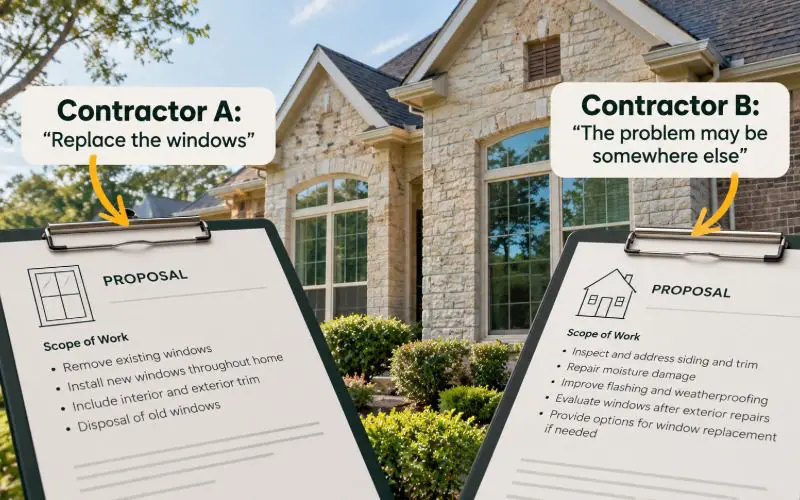
You invite two contractors to evaluate the same house and receive two completely different recommendations. One says a repair should solve the problem, while the other says complete replacement is required. One says your existing sheathing can stay; another includes new sheathing throughout the project. By the end of the appointments, you may have more information but feel less certain about what your home actually needs.
Conflicting recommendations are common in window, siding, and other exterior remodeling projects. Contractors may sell different products, follow different installation methods, define the project scope differently, or have varying levels of experience.
To help homeowners make sense of these disagreements, we spoke with Darryn Finn, a consultant who has worked with Allied Exteriors for more than two decades. Darryn has served in several roles across the company, giving him a broad understanding of exterior remodeling, installation practices, and the decisions that shape contractor recommendations.
Allied Exteriors has served Texas homeowners since 1988 and currently provides window and siding services throughout the Houston, Dallas–Fort Worth, and Austin areas. Drawing on decades of experience evaluating homes and guiding homeowners through remodeling decisions, Darryn explains why contractors can inspect the same property and still recommend different solutions.
In this article, you’ll learn what can cause conflicting contractor recommendations, which differences may signal concerns about quality or sales tactics, and what questions you can ask to determine which recommendation is best supported and most appropriate for your home.
Executive Summary
When contractors give you conflicting recommendations, do not assume the lowest price, highest price, or most confident explanation is automatically correct.
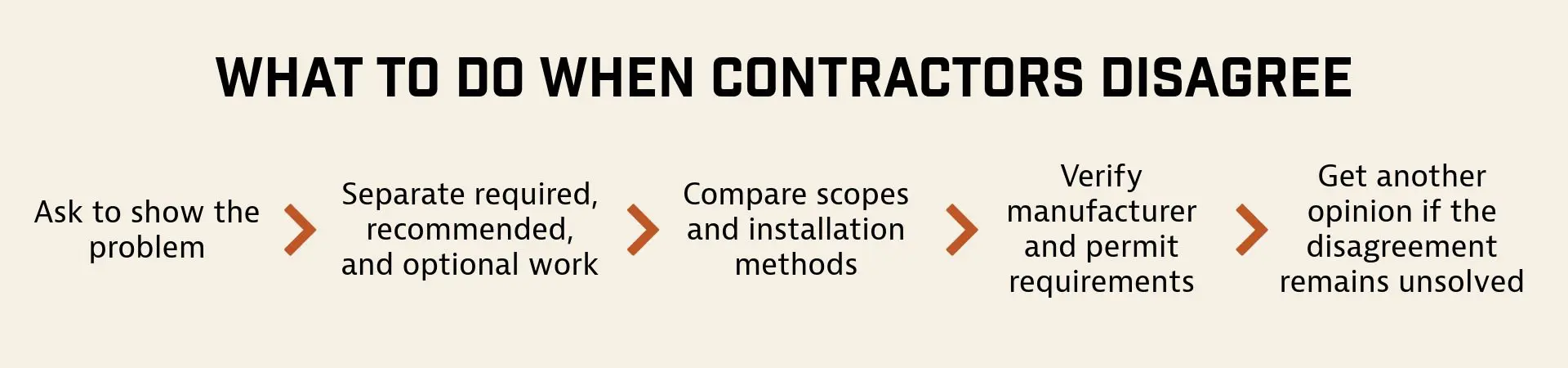
Ask each contractor to show you what they found, explain how the proposed work solves the actual problem, and identify which parts of the recommendation are required, recommended, or optional. Then compare the scopes of work, not just the total prices.
The strongest recommendation will usually:
- Be supported by photos, measurements, product documentation, or other evidence
- Address the cause of the problem rather than only the visible symptom
- Follow applicable manufacturer instructions, building requirements, and permit rules
- Clearly explain potential additional costs and hidden conditions
- Fit your priorities, budget, and long-term plans for the home
Why Do Contractors Give Different Recommendations for the Same House?
A contractor’s recommendation is influenced by more than the visible condition of your home.
It may also reflect:
- The contractor’s experience
- The services the company provides
- The products the company sells
- The company’s preferred installation process
- How thoroughly the contractor inspected the home
- The price point the contractor is trying to reach
- The contractor’s understanding of your goals
That is why two contractors can look at the same project and propose two very different solutions.
How Does a Contractor’s Specialization Affect Their Recommendation?
Contractors tend to evaluate a home through the lens of the work they perform most often.
For example, a company that only replaces windows may focus primarily on the condition of the windows themselves. It may not spend as much time evaluating the surrounding siding, exterior trim, wall structure, or attic ventilation.
That does not automatically make the company unqualified to install windows. However, it may result in a narrower recommendation.
Suppose you call because water appears around a window during heavy rain. One contractor may conclude that the window needs to be replaced. Another may discover that deteriorated trim, improper flashing, or a siding issue is allowing water into the opening.
Both may recommend a new window, but only one may account for the larger cause of the problem.
This distinction matters because a homeowner could end up with a new product without fully resolving the original concern.
Can a Company’s Product Offerings Influence Its Advice?
Most contractors naturally recommend products and services they can provide.
A contractor who does not offer siding may be less likely to recommend addressing the siding first. A company with one window line may present that product as the best fit for most homes. A contractor specializing in premium products may be less enthusiastic about a basic option, while a budget-focused company may emphasize keeping the initial price as affordable as possible based on the salesman’s perception of what they think the customer is willing to spend.
That does not mean every recommendation is self-serving. Contractors build expertise around the products and systems they use and are most familiar with.
Still, homeowners should recognize that recommendations are rarely made in a vacuum.
Ask yourself:
Is the contractor recommending this because it is clearly the best solution for my home, or because it is the only solution the company sells?
A trustworthy contractor should be able to explain where its recommendation fits, and where it may not.
Can Sales Goals Affect What a Contractor Recommends?
Yes. Sometimes a contractor recommends additional work because completing it at the same time genuinely makes financial or practical sense.
For example, replacing soffit and fascia during a siding project may cost less than bringing another crew back several years later. Replacing all the windows at once may reduce repeated labor, delivery, and setup costs compared with completing the project in several phases.
That type of recommendation may technically be an upsell, but it can still serve the homeowner’s interests.
The concern is when a contractor recommends the most expensive option without connecting it to anything you said you wanted to accomplish.
There is a difference between:
“Based on the noise and comfort problems you described, this upgraded glass package may perform better.”
And:
“This is our best window, so this is what you should buy.”
A good contractor should be able to tell you why he chose a certain solution or product, and how that particular selection can solve your problem.
When Is It Reasonable for Contractors to Disagree?
Contractors can reasonably reach different conclusions based on what they observe, how they approach installation, and what they expect to find once the project begins.
A disagreement may be reasonable when both contractors:
- Can show you what they observed
- Clearly explain their reasoning
- Acknowledge the benefits and limitations of their approach
- Follow applicable product requirements and building standards
- Are transparent about cost and risk
- Connect the recommendation to your priorities
For example, two contractors may agree that your siding needs to be replaced but disagree about whether all existing sheathing should automatically be removed.
One may include complete replacement as a standard part of its system. Another may plan to inspect the sheathing after the siding is removed and replace only damaged areas.
Those may be different but potentially acceptable approaches, provided both contractors explain how they will evaluate the wall and what happens if damage is found.
An example Darryn Finn gave is one customer who wanted window and siding replacement to make the home more comfortable and energy efficient. He recommended sheathing replacement (while another contractor had not), so Allied could also upgrade the old blown-in wall insulation in their walls. Darryn’s recommendations were obviously more costly than the other guy, but they better addressed the customer’s overall goals of energy efficiency when the project was completed.
Common Areas Where Contractor Recommendations Differ
| Area of disagreement | Recommendation A | Recommendation B |
| Repair or replace | Repair the affected area | Replace the entire system |
| Project size | Replace only the problem windows | Replace all windows at once |
| Sheathing | Keep existing materials | Install new sheathing |
| Product level | Use a standard product | Upgrade for durability or performance |
| Installation | Use a basic installation method | Include additional flashing, insulation, or preparation |
| Hidden damage | Address damage if it appears | Budget for likely repairs in advance |
| Timing | Complete everything now | Phase the project over time |
| Permits | No permit is needed | A permit or inspection is required |
The existence of a disagreement is less important than the quality of the explanations behind it.
What Are the Most Common Conflicting Recommendations Homeowners Receive?
Although every home is different, several disagreements appear frequently during window and siding consultations. In each case, either recommendation may be reasonable depending on the condition of the home, the homeowner’s goals, and the evidence supporting the proposed work.
“You Only Need a Repair” Versus “You Need Full Replacement”
When a repair may make sense: A repair may be appropriate when the problem is isolated, the surrounding materials remain in good condition, and the repair is likely to provide a reasonable service life.
When full replacement may make sense: Replacement may be more appropriate when problems appear throughout the system, the existing materials are near the end of their useful life, the original installation is failing, or repeated repairs are likely to cost more over time.
What should you ask? Ask each contractor to show you the extent of the problem, explain how long the repair is expected to last, and identify the conditions that make full replacement necessary. Make sure you understand the trade-offs involved in “repair” vs “replace.”
“Your Existing Sheathing Can Stay” Versus “You Need New Sheathing”
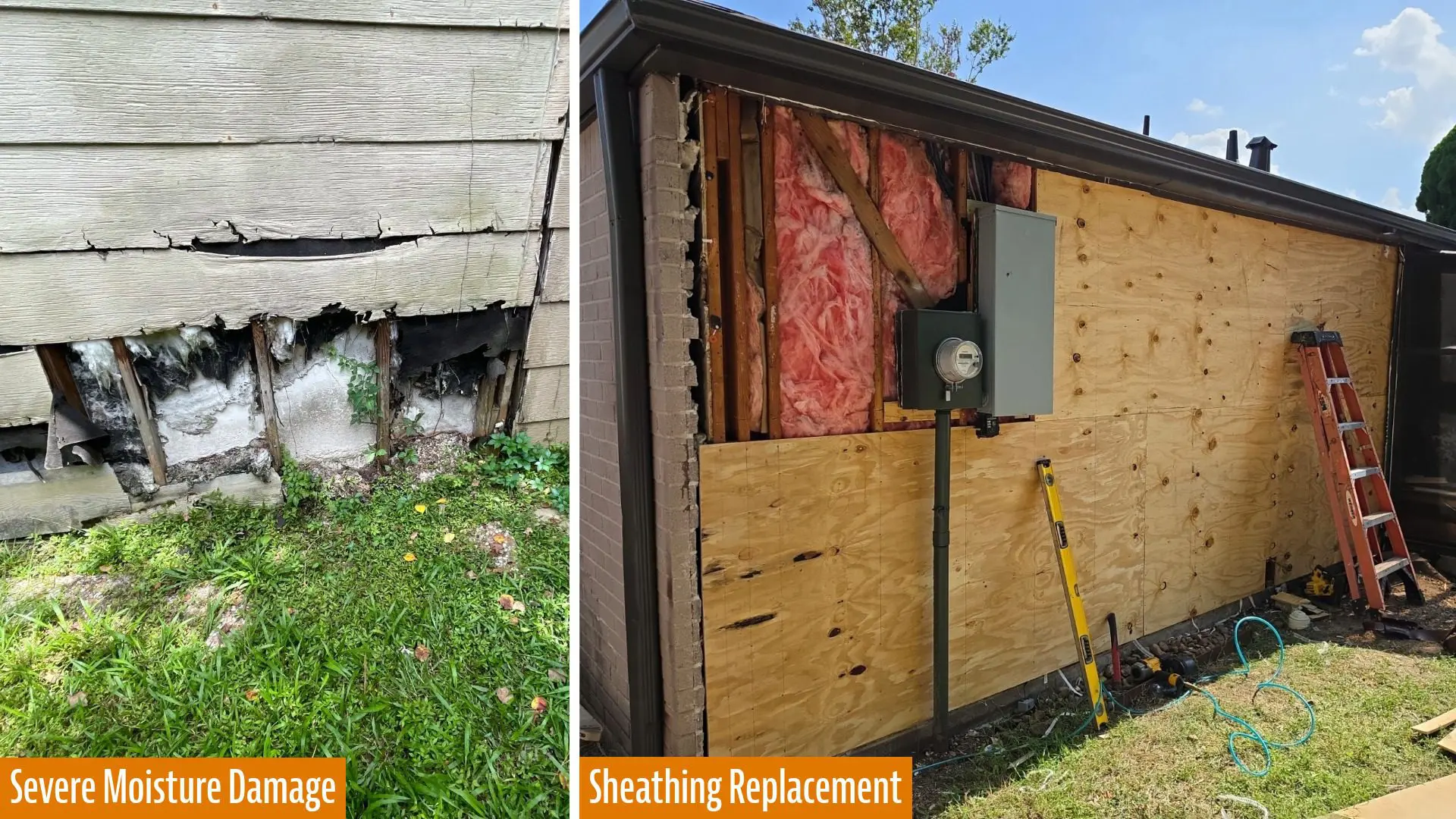
When keeping the existing sheathing may make sense: Existing sheathing may remain when it is structurally sound, compatible with the new siding system, and free from significant moisture damage or deterioration.
When new sheathing may make sense: Replacement may be appropriate when the sheathing is damaged, missing in areas, does not provide an adequate installation surface, or must be changed to meet the requirements of the planned wall system.
What should you ask? Ask whether the sheathing can be fully evaluated before removal, how its condition will be documented once exposed, what criteria will determine whether replacement is needed, and how additional work will be priced and approved.
“A Basic Product Is Enough” Versus “You Need a Premium Product”
When a basic product may make sense: A standard product may be sufficient when your primary goals are improving appearance, replacing a failed component, or completing the project within a limited budget.
When a premium product may make sense: An upgraded product may be worthwhile when you are trying to improve comfort, reduce outside noise, manage significant heat exposure, increase durability, or avoid replacing the product again in the near future.
What should you ask? Ask the contractor to explain the specific differences in materials, performance, warranty, expected service life, and installation requirements. Also ask what you would give up by choosing the lower-priced option.
“Replace Everything Now” Versus “Complete the Project in Phases”
When completing the project in phases may make sense: Phasing may be reasonable when only part of the home is currently failing, some products still have useful life remaining, or completing the entire project at once would exceed your budget.
When replacing everything now may make sense: A full project may reduce repeated labor, delivery, and setup costs. It may also create a more consistent appearance and allow related problems to be addressed at the same time and reduce the amount of disruption to your home.
What should you ask? Ask for the cost of completing the entire project and the cost of each phase. Find out whether delaying part of the work could affect pricing, product availability, appearance, warranties, or future installation costs.
“You Need a Permit” Versus “A Permit Is Not Necessary”
When a permit may not be required: Some projects or jurisdictions may not require a permit for the proposed scope of work. However, the work may still need to follow applicable safety, product, and building requirements.
When a permit may be required: A permit or inspection may be necessary depending on the property’s location, the project scope, structural changes, or requirements related to safety glazing and emergency escape openings.
What should you ask? Ask whether a permit is required for your address and project scope, who verified the requirement, who is responsible for obtaining the permit, whether the fee is included, and which standards still apply if no inspection is required. Most projects inside the city limits will likely require a permit, while homes in the suburbs likely will not.
How Can You Determine Which Contractor Has the Stronger Recommendation?
When contractors give you conflicting advice, do not begin by comparing prices or deciding which person sounds more confident.
Start by asking each contractor to explain how they reached their conclusion.
A useful first question is:
“Can you show me exactly what you found?”
The contractor may point to visible damage, provide photos, take measurements, reference moisture readings, or show you product instructions and installation requirements. The type of evidence will depend on the problem, but the recommendation should be based on more than opinion alone.
Once you understand what each contractor observed, evaluate the recommendations using four questions.
1. Does the Recommendation Solve the Actual Problem?
The proposed work should address the reason you contacted a contractor in the first place.
For example, replacing a window may not solve a leak if water is entering through damaged trim, siding, or flashing. Similarly, installing a premium product may not improve comfort if the larger issue is poor insulation or ventilation elsewhere in the home.
Ask the contractor to explain:
- What is causing the problem?
- How will the proposed work correct that problem?
- Could another condition be contributing to it?
- How will you know the problem has been resolved?
The strongest recommendation should address the source of the problem and not only the most visible symptoms.
2. Is the Recommendation Supported by Evidence?
Give more weight to the contractor who can show you what they found and clearly explain how that evidence supports the proposed work.
Useful evidence may include:
- Photos of damage or installation problems
- Measurements or moisture readings
- Product specifications
- Manufacturer installation instructions
- Warranty requirements
- Building-code or permit information
- A detailed written scope of work
Experience matters, but statements such as “I have been doing this for 30 years” should not be the entire explanation. Experience should help a contractor explain the recommendation more clearly, not replace the need for evidence.
3. Does the Recommendation Follow Applicable Requirements?
Ask whether the proposed work follows the manufacturer’s installation instructions, warranty requirements, applicable building codes, and local permitting rules.
Some parts of a proposal may be:
- Required by code
- Required by the manufacturer
- Necessary to protect a warranty
- Recommended as a best practice
- Optional upgrades
Those categories are not interchangeable. A contractor should clearly explain which parts of the recommendation are required and which reflect the company’s preferred approach.
4. Does It Fit Your Budget and Long-Term Plans?
The most extensive recommendation is not automatically the right choice for every homeowner.
Consider:
- How long you plan to remain in the home
- Which problems need immediate attention
- Whether the project can reasonably be completed in phases
- How much useful life the existing materials may have
- What it may cost to return and complete the remaining work later
- Whether a lower-priced option creates meaningful trade-offs
Ask each contractor to explain what you gain by choosing the more comprehensive option and what you give up by choosing the less expensive one.
The goal is not to choose the cheapest or most expensive recommendation. It is to choose the solution that is supported by evidence, solves the right problem, follows applicable requirements, and makes sense for your home and priorities.
Questions to Ask When Contractor Recommendations Do Not Match
| Ask the contractor… | What the answer should help you understand |
| Can you show me exactly what you found? | Whether the recommendation is supported by visible evidence |
| How did you determine this is causing the problem? | Whether the contractor identified the actual source of the issue |
| Is this work required, recommended, or optional? | How necessary the work really is |
| What happens if I do not address it now? | The risk of delaying or declining the work |
| Is there a less expensive alternative? | Whether another reasonable solution exists |
| What would I be giving up by choosing that option? | The trade-offs in performance, durability, or warranty coverage |
| Why might another contractor have recommended something different? | Whether the disagreement is related to scope, product, experience, or installation method |
| Does the manufacturer require this? | Whether the recommendation is supported by written installation requirements |
| Does a building code or permit requirement apply? | Whether the recommendation is based on safety or local rules rather than preference |
| Could the recommendation or price change after materials are removed? | What hidden conditions may affect the final scope |
| How will unexpected work be documented and approved? | Whether you will be informed before additional costs are added |
| Would you make the same recommendation for your own home? | Whether the contractor genuinely believes the added work is worthwhile |
The goal is not to find the contractor who sounds the most confident. It is to find the recommendation that is best supported, clearly explained, and most closely connected to the problems you are trying to solve.
How Can You Verify Whether a Recommendation Is Required?
Check the manufacturer’s installation instructions
Manufacturer instructions are one of the most useful tools for separating preference from requirement.
For siding, the manufacturer may specify details such as:
- Fastener specifications and placement
- Nail depth
- Required clearances
- Flashing
- Joint treatment
- Starter strips
- Water-resistive barriers
- Approved installation methods
For windows, documentation may address:
- Opening preparation
- Fastening
- Shimming
- Insulation
- Flashing
- Sealants
- Water management
- Required safety glazing
- Product limitations
A contractor should be able to show how its proposed installation follows the applicable instructions.
This matters for more than appearance. Improper installation can affect performance, longevity, and warranty coverage.
Determine Whether Multiple Installation Methods Are Approved
Sometimes. Manufacturer guidelines may allow more than one approved installation method. The appropriate method can depend on the existing construction, product type, exposure, and project conditions.
In that situation, ask each contractor to explain:
- Why the method is permitted
- Why it is appropriate for your home
- What risks or trade-offs it creates
- How it affects warranty coverage
- What happens if the conditions found after removal differ from expectations
A different approach is not automatically a shortcut.
But when one contractor proposes leaving out a component another includes, “we have always done it this way” is not enough. The contractor should be able to connect the decision to written requirements and the actual construction of your home.
Confirm Applicable Codes and Permit Requirements
Some recommendations are not simply product preferences. They may involve health, safety, structural, or emergency-egress requirements.
Codes and permitting processes can differ by city and jurisdiction. Even neighboring communities may administer similar projects differently.
How Can Local Climate Affect Contractor Recommendations?
Based on our experience serving homeowners throughout Houston, Dallas–Fort Worth, and Austin, climate and exposure can also influence what contractors emphasize:
- In Houston, moisture management, humidity, flashing, and wind-driven rain may receive more attention. In the Texas Gulf Coast, homes located within designated coastal windstorm zones may need an approved impact-protection system to satisfy TWIA requirements.
- In Dallas–Fort Worth, hail exposure and large temperature changes may affect conversations about glass, exterior materials, and durability.
- In Austin and Central Texas, prolonged heat and UV exposure may influence product and finish recommendations.
These regional conditions do not mean every home automatically needs the most upgraded product available. They should simply be part of a contractor’s evaluation.
When Should You Get Another Opinion?
You are allowed to pause when two contractors give you significantly different recommendations.
However, scheduling more estimates is not always the best next step. If one contractor has thoroughly inspected the home, clearly explained the problem, supported the recommendation, and provided a detailed scope, additional appointments may only introduce more products, prices, and opinions.
Another opinion is most useful when it helps answer a specific unresolved question.
When Should You Ask a Third Contractor?
Consider getting a third contractor’s opinion when:
- The first two recommendations are dramatically different
- One proposal includes work the other says is unnecessary
- The cost difference is substantial
- Neither contractor can clearly support the recommendation
- The contractors appear to be diagnosing different causes
- You still do not understand which work is required, recommended, or optional
When speaking with the third contractor, explain the issue you are trying to resolve rather than simply asking for another estimate.
For example, you might say:
“One contractor says all of the sheathing should be replaced, while another plans to replace only damaged areas. Can you evaluate the wall assembly and explain which approach is appropriate?”
The purpose of a third opinion is to clarify the disagreement—not to keep collecting prices until someone gives you the answer you hoped to hear.
When Should You Hire an Independent Specialist?
A third contractor may not be the right person to resolve every disagreement. When the issue involves higher-risk conditions, consider hiring a qualified professional who is not bidding on the remodeling project.
Depending on the concern, that could include:
- A structural engineer
- An independent home inspector
- A qualified moisture-intrusion specialist
An independent specialist may be appropriate when the disagreement involves:
- Structural movement or framing damage
- Significant or recurring water intrusion
- Widespread moisture damage
- A disputed safety or building-code concern
- Repairs that could add thousands of dollars to the project
Because the specialist is not trying to sell the installation, their role is to evaluate the condition and help clarify what work may be necessary.
An independent evaluation will add cost, but it may be worthwhile when making the wrong decision could lead to continued damage, unnecessary work, or a much larger expense later.
What Red Flags Should Make You Question a Recommendation?
Conflicting recommendations are not inherently suspicious. How a contractor handles the disagreement tells you much more.
The Contractor Cannot Show or Explain the Problem
A contractor may occasionally identify a concern based on experience before it can be fully confirmed.
However, the contractor should still be able to explain the visible clues that led to the concern and what will be done to verify it. Vague warnings without evidence can be used to create fear.
The Contractor Criticizes Competitors Instead of Explaining the Work
A professional response sounds like:
“That approach may be less expensive because it does not include new flashing. Here is why our proposal includes it.”
A less helpful response sounds like:
“That company has no idea what it is doing.”
Competitor criticism does not prove that the contractor’s own recommendation is correct.
Every Problem Requires the Most Expensive Product
Not every homeowner needs the contractor’s premium option.
A good consultant may recommend an upgrade when it directly supports your goals. They should also explain where a less expensive choice may still be reasonable and what trade-offs it involves.
The Recommendation Does Not Match Your Goals
You may say that you plan to sell the home in two years, only need to address several failing windows, and want a practical mid-range option.
If the contractor continues steering you toward a whole-home premium package without explaining why, the recommendation may be more connected to the sale than to your priorities.
The Contractor Uses Urgency to Prevent Verification
Be cautious when you are told:
- The recommendation cannot be put in writing
- The price disappears before you can review the documentation
- You should not speak with another contractor
- There is no time to check permit or manufacturer requirements
- You must sign immediately to get this deal or price is only good for today
A legitimate safety concern should be clearly documented. It should not depend on whether you sign a contract before the contractor leaves your kitchen table.
The Proposal Is Too Vague to Compare
A proposal that simply says “replace siding and trim” or “install 12 windows” leaves too many unanswered questions.
A detailed estimate should make it easier to identify:
- What is being removed
- What is being installed
- Which products are included
- How the work will be completed
- What preparation is required
- How hidden damage will be handled
- Which warranties apply
- What could change the price
Evidence should carry more weight than unsupported opinion. The goal is finding the most appropriate recommendation, not merely the cheapest one.
How Can You Compare Contractor Recommendations Side by Side?
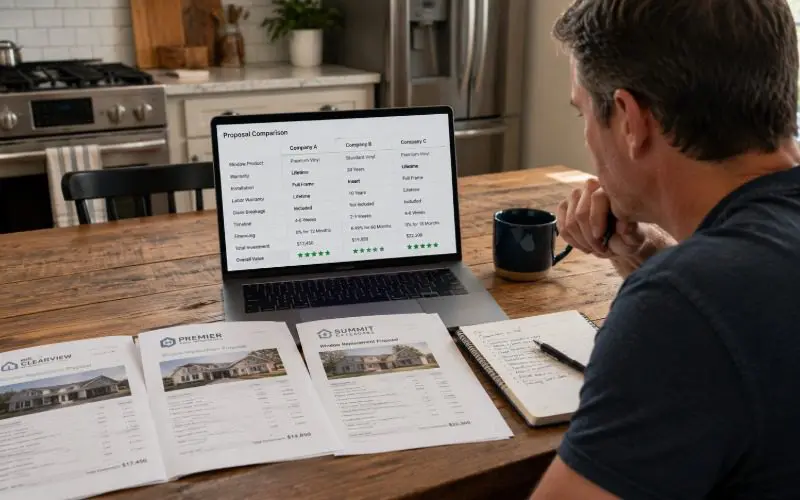
Do not compare proposals by total price alone. Use a simple worksheet to identify where the recommendations actually differ.
| Category | Contractor A | Contractor B | Questions to resolve |
| Problem identified | Are they diagnosing the same cause? | ||
| Scope of work | What is included or excluded? | ||
| Products | Are the products comparable? | ||
| Installation method | Do both follow manufacturer requirements? | ||
| Sheathing or preparation | Is this included, conditional, or excluded? | ||
| Hidden damage | How will it be documented and priced? | ||
| Code and permits | Who verified the requirements? | ||
| Warranty | Does it cover the product, labor, and installation? | ||
| Project timing | Is the work completed at once or in phases? | ||
| Total investment | What could increase the final price? |
Once you fill this out, you may discover that the contractors are not really recommending two prices for the same project.
They may be pricing two different products, two different installation systems, or two different levels of responsibility. That is the comparison that matters.
How Can You Move Forward When Contractors Disagree?
Conflicting contractor recommendations can make an already complicated remodeling decision feel even more uncertain. But disagreement does not always mean one contractor is wrong. Different companies may evaluate risk, installation methods, products, and project scope differently.
You now know that the strongest recommendation is not necessarily the cheapest, most expensive, or most confidently presented option. It is the one that addresses the actual problem, is supported by evidence, follows applicable requirements, and makes sense for your budget and long-term plans.
Your next step is to read our guide on what should be included in a replacement window quote or what should be included in a siding quote so you can compare each proposal side by side.
Allied Exteriors has helped Texas homeowners navigate window and siding decisions since 1988. Our consultants serve homeowners throughout Houston, Dallas–Fort Worth, and Austin by inspecting the home, explaining what they find, and helping homeowners understand the reasoning and trade-offs behind each recommendation. If you are comparing conflicting proposals, our team can evaluate your concerns and provide a clear, documented recommendation for your home.
Frequently Asked Questions
Should You Tell Contractors What Other Bids Cost?
You do not have to share another contractor’s total price, and doing so too early can shift the conversation toward price matching instead of understanding the differences between the proposals.
It is usually more helpful to explain what the other contractor included, such as the product, installation method, sheathing, flashing, warranty, or plan for hidden damage.
For example, you might say: “Another contractor included new sheathing throughout the project. Can you explain why your proposal does not?”
This allows the contractor to explain the difference without knowing the other company’s price or identity.
Should Two Contractors Use the Same Product Before You Compare Prices?
Not necessarily, but the closer the products and scopes are, the more meaningful the price comparison will be.
Two contractors may recommend different manufacturers, product lines, glass packages, siding systems, or warranty levels. Even when the product names are similar, the installation methods and included work may be different.
Can You Ask a Manufacturer to Verify an Installation Claim?
Yes. If contractors disagree about how a product should be installed, you can review the manufacturer’s written instructions or contact its technical support department.
Provide as much detail as possible, including the product line, type of installation, existing construction, and the specific claim you want verified.
A manufacturer may not determine which contractor is best for your home, but it can often clarify whether a proposed method follows its published requirements and whether it could affect warranty coverage.
Is the Cheapest Contractor Always Excluding Something?
No. A lower price does not automatically mean the contractor is cutting corners or leaving out necessary work.
The company may have lower overhead, use a different product, purchase materials at a better rate, or operate more efficiently. The contractor may also be recommending a narrower scope that is still appropriate for your home.
However, a significantly lower bid deserves closer review. Compare the proposals line by line to see whether the lower price excludes preparation, flashing, insulation, trim, permits, cleanup, warranties, or likely repairs.
The goal is not to assume the cheapest contractor is wrong. It is to understand why the price is lower before making your decision.
How Long Should You Take to Compare Estimates?
Take enough time to understand what each contractor is recommending, but avoid continuing to collect bids after your main questions have been answered.
For many homeowners, a few days to a couple of weeks is enough to review the scope, research the products, check references, and ask follow-up questions. More complicated projects involving structural concerns, moisture damage, or major cost differences may require more time or an independent opinion.
You may be ready to decide when you can clearly explain:
- What problem the project is solving
- What each contractor is including
- Why the recommendations differ
- What could change the final price
- Which option best fits your budget and long-term plans
More estimates are not always more helpful. At a certain point, additional appointments can create more confusion instead of greater clarity, a concern Darryn also raised when discussing “analysis paralysis” during the interview.
Allied Exteriors Blog
Whether you’re comparing replacement windows, researching siding materials, or trying to understand project costs, our Learning Center is built to help you make informed decisions before talking with a contractor.