
Why Are Siding Replacement Quotes So Different?
By Chad Ryan | Nov. 9, 2026 | 13 min. read
Siding quotes vary because contractors often aren’t pricing the same scope of work. Differences in materials, waterproofing, labor practices, warranties, and installation methods can create price swings of tens of thousands of dollars even on identical homes.
Why can one contractor quote $22,000 for a siding replacement while another comes back at $34,000 or even $50,000 for what appears to be the exact same house?
Are some contractors overpriced, or are others leaving important parts of the project out of their proposal?
The reality is that, in most cases, those contractors aren’t pricing the same scope of work. While they’re looking at the same house and replacing the same siding, they may have very different plans for the materials they’ll use, how they’ll install them, what’s included in the project, and how they’ll protect your home for the long term.
Siding replacement isn’t a single product with a fixed price tag. It’s a combination of materials, waterproofing systems, installation methods, preparation work, warranties, and dozens of decisions that homeowners never see once the project is complete.
At Allied, we’ve been helping homeowners make informed exterior remodeling decisions since 1988, and we’ve reviewed hundreds of siding proposals across Houston, Dallas, and Austin. Over the years, we’ve found that two estimates can both say “replace siding” while describing two very different levels of work and long-term protection.
In this article, you’ll learn what causes siding quotes to vary so dramatically, what details are often hidden in the fine print, and how to compare proposals based on value instead of simply choosing the lowest number on the page.
Why Can Two Contractors Give Completely Different Prices for the Same Siding Project?
The single biggest reason siding quotes vary so much is because the details often live in the fine print. Or sometimes, they aren’t included at all. One contractor may be pricing a complete siding replacement built around manufacturer best practices and long-term durability.
Another may be pricing only the visible portions of the project while leaving out many of the components that actually determine how long the siding will last.
On paper, both proposals may contain a sentence that looks something like this:
Remove existing siding and install new fiber cement siding.
To a homeowner, those projects sound identical. In reality, they could be worlds apart.
One contractor may include:
- New sheathing
- Premium house wrap
- Window and door flashing
- Ventilation improvements
- Manufacturer-approved fasteners
- Certified installation crews
- Detailed warranty documentation
Another contractor may include none of those items.
The challenge for homeowners is that many of these details disappear behind the finished siding. You don’t see them once the project is complete. Unfortunately, those hidden details are often the difference between siding that lasts thirty years and siding that develops problems after ten.
What Parts of the Scope of Work Are Commonly Left Out of Cheaper Siding Quotes?
When homeowners compare proposals, they naturally focus on the bottom-line price. The problem is that the number at the bottom doesn’t tell you what was left out to get there.
Some contractors reduce costs by simplifying the project scope or excluding portions of the work that may eventually become change orders later. Others may simply have a different philosophy about what constitutes a complete siding replacement.
Here are some of the most common differences:
| Often Included in Detailed Quotes | Commonly Missing in Budget Quotes |
|---|---|
| Full tear-off to framing or substrate | Installing over existing materials |
| Inspection of underlying conditions | Limited or no inspection |
| New sheathing where necessary | Reusing damaged backing materials |
| Premium moisture barriers | Basic felt paper or no house wrap |
| Flashing around windows and penetrations | Heavy reliance on caulk |
| Manufacturer-approved fasteners | Generic fasteners |
| Detailed trim replacement | Reusing aging trim |
| Written warranty documentation | Minimal warranty details |
None of these items are particularly exciting to talk about, but they’re some of the most important parts of the entire project.
How Much Does Siding Material Affect the Cost of a Siding Replacement?
Although Allied only installs James Hardie fiber cement siding, we’ve reviewed countless estimates over the years from contractors recommending everything from vinyl to engineered wood.
One of the biggest reasons siding quotes vary is because homeowners aren’t always comparing the same material.
Typical Material Comparison
| Material | Relative Cost | Expected Lifespan | Maintenance |
|---|---|---|---|
| Vinyl | Lower | Moderate | Moderate |
| Engineered Wood | Mid-range | Moderate | Moderate |
| Fiber Cement | Higher | Long | Low |
For homeowners in markets like Houston, where humidity, heavy rain, and hurricane-season weather are constant concerns, fiber cement products such as James Hardie are often considered a premium siding option because of their durability and moisture resistance.
In the Austin market, homeowners are often balancing durability with modern architectural styles and energy efficiency goals.
Meanwhile, in the Dallas area, homeowners frequently prioritize hail resistance, heat performance, and long-term maintenance costs.

So even if you’ve narrowed your search to fiber cement siding, you’re still not necessarily comparing apples to apples. Two contractors may both specify fiber cement, but they could be quoting different product lines, trim packages, installation details, paint systems, and accessories.
Simply seeing “fiber cement siding” on two estimates doesn’t mean you’re getting the same product or the same installation.
Why Does Siding Installation Quality Matter So Much?
With some remodeling projects, poor workmanship creates cosmetic issues.
With siding, poor workmanship can create water problems.
That’s an entirely different level of risk.
- Improper flashing.
- Improper fasteners.
- Incorrect clearances.
- Poor moisture management.
Many installation mistakes aren’t visible immediately. In fact, some may take years to reveal themselves.
By then, the contractor may be gone, the manufacturer warranty may be voided, and the repairs can become significantly more expensive than doing it correctly in the first place.
Good siding contractors spend a lot of time discussing parts of the project homeowners may never see again once the work is complete.
That’s not because they’re trying to upsell hidden extras. It’s because some of the most expensive siding failures start behind the siding itself.
That attention to detail becomes even more important in Texas climates. The installation methods that work well in dry parts of the country may not hold up to Gulf Coast humidity in Houston or the severe hail and wind events common around Dallas and Central Texas.
What Should Be Included in a Professional Siding Quote?
At a minimum, every professional siding proposal should answer three important questions:
What siding products and materials are being installed?
A homeowner should never have to guess what materials are being used on their home.
A quality proposal should clearly identify:
- Manufacturer name
- Product line
- Style and texture
- Trim products
- Paint systems
- Moisture barriers
- Flashing materials
If your proposal simply says:
Install new siding.
That is usually a sign that additional questions need to be asked.
How will the siding actually be installed?
The installation process matters just as much as the siding itself.
Your quote should explain:
- How existing materials will be removed
- What inspections will occur during demolition
- How moisture management will be handled
- How flashing will be installed
- How trim will be replaced
- What cleanup will look like
Generally speaking, contractors who perform siding work every day tend to provide far more detail because they already know the questions homeowners will eventually ask.
What warranties are included?
Warranties are one of the most misunderstood parts of home improvement contracts.
Many homeowners hear the phrase “lifetime warranty” and assume that means everything is covered forever.
Unfortunately, that’s rarely the case.
Most siding projects involve two separate warranties:
| Warranty Type | What It Covers |
|---|---|
| Manufacturer Warranty | Defects in the product itself |
| Workmanship Warranty | Installation-related issues |
Understanding who is responsible for what, and how long they’ll be around to honor those commitments, is often just as important as the warranty length itself.
This is particularly important in fast-growing markets such as Austin and Houston, where new contractors enter the market every year. A 30-year warranty doesn’t provide much peace of mind if the company offering it isn’t around in five years.
Why Are Some Siding Quotes So Much Cheaper?
Finding a lower quote isn’t automatically a red flag.
Sometimes companies simply operate differently. Sometimes they’re using different materials. And sometimes they genuinely have lower overhead.
But in many cases, lower pricing comes from one of four places.
Less work is included.
The proposal may exclude:
- Sheathing
- Flashing
- Trim replacement
- Moisture barriers
- Disposal costs
Lower-cost materials are being used.
This may include:
- Generic siding products
- Builder-grade accessories
- Lower-end paint systems
- Basic house wrap
The contractor expects change orders later.
Unfortunately, some contractors intentionally keep pricing low to secure the project and then revisit pricing after demolition begins.
Once siding has been removed and the home is exposed to the elements, homeowners often feel they have little choice but to proceed.
This is one reason homeowners in competitive markets like Houston and Dallas often see dramatic swings in pricing. In larger metro areas with hundreds of contractors competing for projects, pricing strategies can vary just as much as installation practices.
The contractor underestimated the project.
Not every low quote is malicious.
Sometimes the contractor simply doesn’t perform enough siding projects to fully understand what the project will require. As a result, important details can be overlooked during the estimating process, leading to unexpected costs or changes once work begins.
One way to protect yourself is to ask questions about how the estimate was developed. For example:
- Approximately how many siding replacement projects do you complete each year?
- What assumptions did you make when preparing this estimate?
- What items are most likely to result in a change order?
- How do you handle hidden issues like damaged sheathing if they’re discovered during the project?
Why Is One Siding Quote So Much More Expensive Than Another?
Just as low prices aren’t always bad, higher prices aren’t automatically better.
Sometimes higher pricing reflects genuine value. Sometimes it reflects overhead. And occasionally, it reflects aggressive sales models.
Legitimate reasons for higher pricing often include:
- More experienced crews
- Better project management
- Higher-quality materials
- Larger insurance coverage
- Longer warranties
- More detailed preparation work
The key question isn’t: Why are they more expensive?
It’s: What am I receiving for the additional investment?
If the answer is clear and measurable, the higher price may be justified.
If it isn’t, it deserves further scrutiny.
Is the Most Expensive Siding Quote Always the Best?
Not always. The highest quote isn’t automatically the best value any more than the lowest quote is automatically the best deal.
The goal isn’t to find the cheapest contractor. The goal is to find the best combination of quality, preparation, warranty protection, and price.
One of the best questions you can ask every contractor is:
“What am I getting in your proposal that I am not getting in the others?”
Good contractors usually love this question. It gives them an opportunity to explain their process and justify their value.
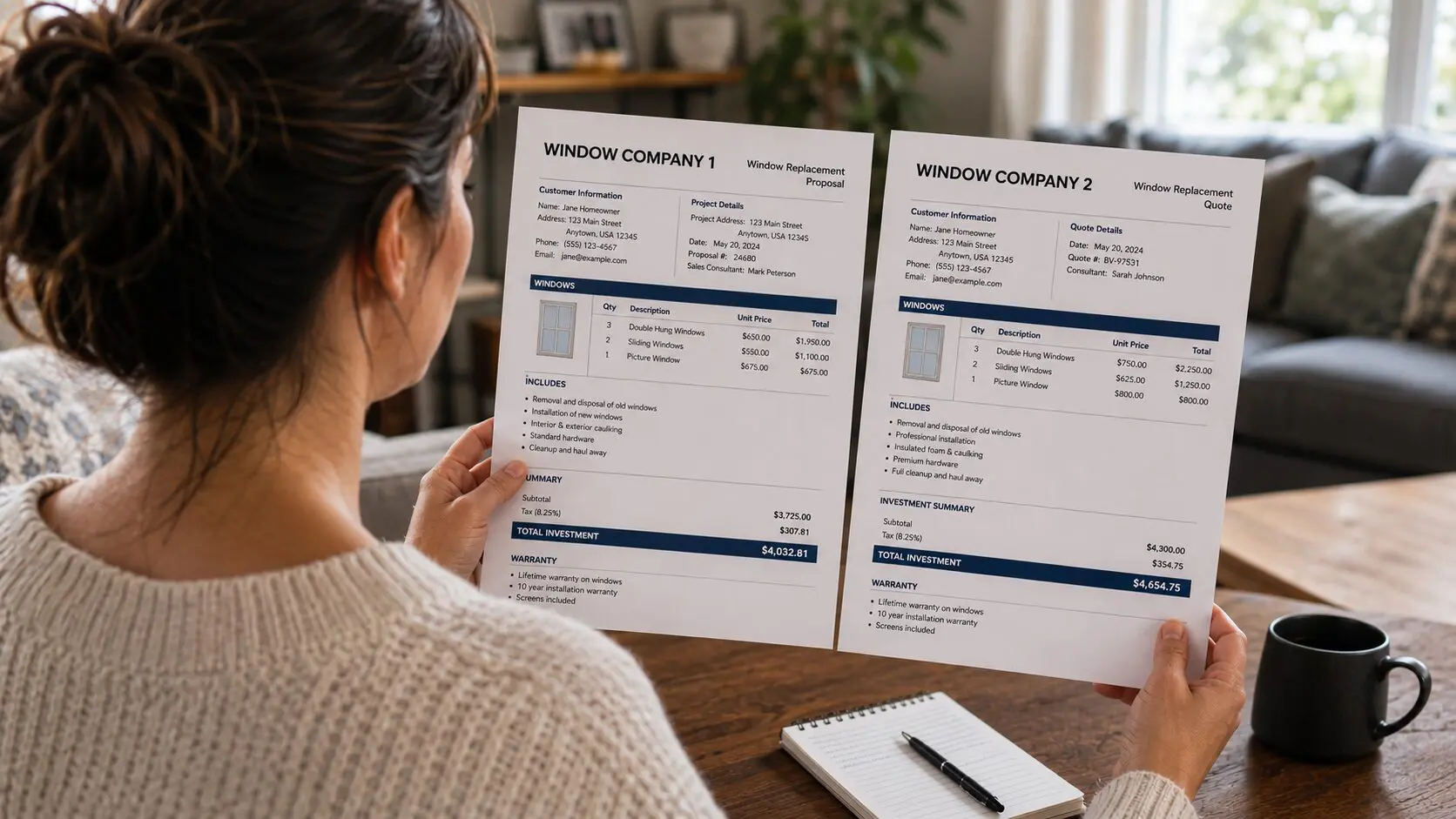
How Do You Compare Siding Quotes Fairly?
Once you understand what drives pricing differences, comparing estimates becomes much easier.
Instead of asking: Which quote is cheaper?
You can start asking: Which quote includes more of the project I actually want completed?
A good comparison checklist includes:
- ✓ Manufacturer and product line listed by name
- ✓ Installation methods explained in writing
- ✓ Flashing details included
- ✓ Moisture barrier specified
- ✓ Warranty documentation provided
- ✓ Insurance coverage verified
- ✓ Permit responsibilities clarified
- ✓ Payment schedule clearly outlined
If one proposal answers all of these questions and another doesn’t, you may not actually be comparing the same project.
If you’re comparing multiple proposals, our guide on how to compare contractor quotes using ChatGPT walks you through how to identify differences in scope, materials, warranties, and pricing in just a few minutes.
Why Are Siding Quotes So Different From Contractor to Contractor?
At the end of the day, wildly different siding quotes usually don’t mean one contractor is honest and another is dishonest. More often, they mean you’re looking at different scopes of work, different installation standards, and different levels of long-term protection for your home.
Now that you understand what drives those price differences, from materials and moisture management to warranties and preparation work, you’re in a much better position to evaluate proposals based on value instead of simply comparing the number at the bottom of the page.
For homeowners in Houston, Dallas, and Austin, that distinction matters. The heat, humidity, storms, and weather conditions common throughout Texas make proper installation details just as important as the siding product itself.
Since 1988, Allied has helped Texas homeowners navigate these decisions by focusing on transparency, education, and helping buyers understand exactly what they’re paying for before construction begins.
Your next step should be reading “What Should Be Included in a Siding Replacement Quote?” so you know exactly what belongs in a professional proposal and can compare contractors with confidence before making your final decision. And if you have any questions about your siding project, don’t hesitate to reach out to the Allied Exteriors team.
Allied Exteriors Blog
Whether you’re comparing replacement windows, researching siding materials, or trying to understand project costs, our Learning Center is built to help you make informed decisions before talking with a contractor.