
How Many Window Quotes Should You Get in 2026?
By Eric Pope | Oct. 9, 2026 | 19 min. read
Executive Summary: You don’t automatically need three window bids to make an informed decision. If you’ve already researched the companies, products, warranties, and pricing, one or two quotes may be enough. However, if you still have questions about the cost, installation process, product quality, or whether you can trust the contractor, getting another estimate can help. The goal isn’t to collect a specific number of quotes. It’s to gather enough information to feel confident in your decision.
If you’re planning to replace your windows, you’ve probably heard the old advice: Always get three bids.
For decades, that was a reasonable way to shop for a major home improvement project. Before online reviews, detailed contractor websites, manufacturer information, and transparent pricing were readily available, meeting with several companies was one of the only ways to figure out who you could trust and what your project should cost.
But homeowners have access to significantly more information in 2026.
Before inviting anyone into your home, you can research a company’s reputation, read positive and negative reviews, investigate the windows they install, learn about warranties, look at past projects, and sometimes even get a realistic idea of pricing.
So, do you really need three window quotes anymore?
Not necessarily. For an informed homeowner who has thoroughly researched their options, one or two window bids may be enough. If you still have questions about pricing, products, installation, or which company you trust, getting additional bids can absolutely be worthwhile.
At Allied Exteriors, we sell and install replacement windows, so we obviously have a stake in this conversation. To provide some perspective from inside the industry, we interviewed Eric Pope, Director of Sales at Allied Exteriors, who has spent years working directly with homeowners during the window-buying process.
In this article, we’ll explain why the three-bid rule is changing, how to research window companies before scheduling an appointment, and how to know when you have enough information to make your decision.
How Many Window Bids Should You Get?
There is no required number. Start with the strongest company your research identifies. If you still have meaningful questions after that appointment, get another quote.
| Your Situation | A Reasonable Approach |
| You’ve thoroughly researched one company and it clearly stands out | Start with 1 bid |
| You’ve narrowed your search to two comparable companies | Get 2 bids |
| You have several companies you genuinely can’t distinguish between | Consider 2–3 bids |
| Your first appointment raises concerns or leaves questions unanswered | Get another bid |
| You aren’t comfortable judging pricing or contractors through online research | 3 bids may still be helpful |
| You’ve used the contractor before and had a great experience | You may only need 1 |
Two quotes can be plenty if you’ve already narrowed your options to comparable contractors.
For example, suppose you’ve researched two established window companies in your area. Both have strong reputations. Both offer products you’re interested in. Both provide the level of installation and service you’re looking for.
At that point, meeting with both can help you compare the remaining differences without unnecessarily adding a third, fourth, and fifth company.
Is the Traditional Three-Bid Rule Still Relevant in 2026?
The three-bid rule isn’t bad advice. It’s just no longer the only way to protect yourself as a homeowner.
The advice largely comes from a time when homeowners had significantly less information available before an appointment.
You might have found a contractor through the phone book, a newspaper advertisement, a neighbor, or a yard sign. Other than what the salesperson told you at your kitchen table, it could be difficult to know how long the company had been around, what customers thought of them, what products they installed, or whether their pricing was competitive.
Getting three estimates helped fill those information gaps.
Today, much of that research can happen before a contractor ever walks through your door. An informed homeowner can potentially narrow a list of 10 window companies down to two strong candidates without scheduling 10 appointments.
That doesn’t mean you shouldn’t get three bids. If three estimates would make you more comfortable with your decision, get three.
The important distinction is that three bids should be a tool for answering questions, not an arbitrary requirement you have to meet before you’re “allowed” to choose a contractor.
Getting multiple estimates is still widely recommended as a consumer-protection practice. The Federal Trade Commission recommends getting multiple written estimates and specifically advises homeowners not to automatically choose the lowest bidder.
One important caveat: Saying you may not need three bids is not the same as saying a contractor should discourage you from getting them. If a company pressures you to buy before you can compare estimates or makes a price contingent on signing immediately, consider that a red flag. You should decide when you have enough information to move forward.
How Can You Research Window Companies Before Getting Quotes?
Think of your online research as the first round of interviews.
Before scheduling an in-home consultation, you can learn quite a bit about a contractor and determine whether they actually belong on your shortlist.
Read the Good and Bad Reviews
Don’t just look at the star rating.
Read detailed reviews describing the actual installation experience, communication, service after installation, and how problems were handled.
Eric specifically recommends looking for negative reviews.
Every company that completes enough projects will eventually have an unhappy customer or make a mistake. What can be more revealing is how the company responds when something goes wrong.
Did they ignore the complaint? Become defensive? Or acknowledge the issue and make an effort to resolve it?
Check the Company’s Reputation
Look at how long the company has been operating, its BBB profile, unresolved complaints, and its presence in your local market.
Longevity isn’t an automatic guarantee of good work, but these details help you understand who you’re considering before giving them several hours of your time.
Find Out What Windows They Actually Install
You should ideally know which manufacturers and product lines a contractor offers before the appointment.
Then research those products independently.
Look at the manufacturer’s warranty, available materials, glass packages, construction, and reputation.
If a company doesn’t tell you what it installs online, ask before scheduling.
Look at What the Company Is Willing to Teach You
Websites, YouTube, and social media can tell you something about a contractor’s approach.
Is everything you find essentially an advertisement asking you to schedule an appointment?
Or does the company openly discuss subjects such as pricing, product limitations, installation, warranties, and who may not be a good fit for its services?
The more information you can gather beforehand, the fewer basic questions you’ll need an in-home appointment to answer.
Use Community Recommendations Carefully
Neighborhood groups and people you personally know can also be useful resources.
Ask homeowners who have recently replaced their windows:
- Which company did you use?
- Were you satisfied with the installation?
- How was communication?
- Would you hire them again?
- Did the final price match what you expected?
Online forums such as Reddit can provide useful perspectives as well, but individual experiences aren’t necessarily representative of every project. Treat them as one piece of your research rather than definitive proof that a company is good or bad.
What Can You Only Learn During a Window Appointment?
Online research can eliminate a lot of companies, but it can’t tell you everything.
Eventually, someone needs to look at your house.
Two of the biggest things Eric recommends evaluating during the appointment are the actual window and the installation process.
You should have an opportunity to see and feel the product you’re considering. More importantly, ask the contractor to explain how your existing windows will be removed and how the replacements will be installed, sealed, secured, and finished.
The appointment also gives you an opportunity to compare the company you researched online with the company sitting in front of you.
- Does what you’re hearing match what you found during your research?
- Do they answer your questions directly?
- Are they transparent about the limitations of their product?
- Do you understand what happens after you sign the contract?
- And, simply, do you feel comfortable trusting this company with your home?
Your online research should narrow the field. The appointment should confirm whether what you found online holds up in person.
Can Getting Too Many Window Quotes Make the Decision Harder?
For some homeowners it can. More information doesn’t always lead to a better decision.
Imagine meeting with five window companies. Each appointment introduces you to another salesperson, manufacturer, glass package, installation process, warranty, price, and set of claims about why that company’s approach is better.
By appointment five, you may remember that someone told you something important about seal failure, but you can’t remember which company it was.
That’s analysis paralysis: a state of overthinking where excessive information or too many choices stop you from making any decision at all. state of overthinking where excessive information or too many choices stop you from making any decision at all.
Eric sees this happen when homeowners schedule appointments before narrowing down what they’re actually looking for.
Instead of calling a random assortment of contractors, first decide what matters to you.
If you know you want a well-established company with dedicated project management and long-term service, compare companies operating at that level.
If your primary concern is getting the lowest possible upfront price, your shortlist will probably look very different.
The goal isn’t to experience every possible type of window company. It’s to compare companies capable of providing the type of project you actually want.
When Should You Get Another Window Bid?
Even if you planned to get only one or two quotes, the first appointment may give you a reason to keep shopping.
The question isn’t whether you’ve reached a certain number of bids. It’s whether the appointment left you with a meaningful concern another contractor could help you evaluate.
That could mean:
- The company couldn’t clearly explain its installation process.
- The warranty wasn’t what you expected.
- The product wasn’t what you researched.
- The price was dramatically outside the range you expected.
- You felt pressured into making an immediate decision.
- The representative spent more time criticizing competitors than explaining their own product.
- Important questions were left unanswered.
- Something simply didn’t feel right.
That last point shouldn’t be ignored: trust your gut.
A contractor can look great online and still not feel like the right fit once you meet them. If that happens, call the next company on your list.
What Does a Typical Window Replacement Project Cost With Allied in 2026?
Price is one of the biggest reasons homeowners traditionally get multiple window bids. Without a point of comparison, it can be difficult to know whether a $8,000, $15,000, or $25,000 proposal is reasonable.
Our own project history gives us a more useful benchmark than a broad national average.
At Allied Exteriors, a typical replacement window project is around $18,000, and is typically although the final investment depends on how many windows you’re replacing and the products, sizes, colors, glass packages, and configurations you choose.
For individual windows, our pricing generally falls into three ranges:
| Window Type | Typical Allied Price Per Window |
| Classic window options | $800–$1,400+ |
| Custom color and design options | $1,400–$2,100+ |
| Architectural and specialty options | $2,000–$2,500+ |
These aren’t three different levels of installation quality. They’re a way to understand how the window itself can change the price of a project.
A more straightforward classic window may fall toward the lower end of the range, while larger, more complex, architectural, or specialty windows can cost $2,000–$2,500 or more per opening.
That context is important when you’re comparing bids. Two contractors could be quoting the same number of windows without necessarily quoting comparable products or project scopes.
And these numbers describe Allied’s pricing, not what every window contractor in Houston, Dallas-Fort Worth, or Austin charges. Other companies may be higher or lower depending on the products they sell, what’s included in their installation, their warranty and service model, and how their businesses are structured.
Interested in digging deeper into the numbers? Our Replacement Window Pricing page explains what affects the cost and what you can expect at different price points.
Why Can Two Window Quotes Be Thousands of Dollars Apart?
Different prices don’t necessarily mean one contractor is ripping you off. You may not actually be comparing the same thing.
One company may have one installation crew and minimal administrative overhead. Another may have project managers, service departments, multiple installation crews, office staff, warranty support, and employees dedicated to communicating with homeowners throughout the project.
Those things cost money. They can also affect what happens when you have a question six months after installation.
Before deciding one estimate is overpriced or suspiciously cheap, compare:
| Compare | Questions to Ask |
| Window | Are these the same material, quality level, glass package, and features? |
| Installation | Is the same removal, sealing, fastening, trim, and finishing work included? |
| Warranty | Who covers the product, glass, labor, workmanship, and future service? |
| Project management | Who communicates with you before, during, and after installation? |
| Service | Who do you call if something goes wrong later? |
| Scope | Are both contractors replacing the exact same windows and including the same work? |
A price comparison only becomes useful once you’re confident the contractors are measuring roughly the same project.
Is the Cheapest Window Quote Usually the Best Value?
Not always, but that doesn’t mean the cheapest contractor is automatically bad, either.
A smaller contractor may have significantly less overhead and be able to install a good window for less money. For some homeowners, that’s exactly what they want.
The tradeoff may be fewer administrative resources, different warranty support, fewer financing options, or less infrastructure if a problem occurs later.
Likewise, the most expensive quote doesn’t automatically mean you’re getting the best window.
Price tells you what a company charges. Your job is to understand what you’re receiving for that price. If one estimate is half the price of every comparable contractor you’ve researched, investigate why.
If another is twice the price, ask the same question.
What If All Your Window Bids Are Wildly Different?
If your window quotes are thousands of dollars apart, first look at which companies you invited to bid the project.
Eric regularly sees homeowners call a budget contractor, a mid-range regional company, and a premium national brand just to see the full range of pricing. The problem is that those companies may offer very different products, service levels, warranties, and overall experiences, so dramatically different prices should be expected.
If you already know you don’t want the cheapest option, there’s little value in spending an appointment getting a quote you never intended to consider. The same applies if you know a premium option is outside your budget.
Instead, compare companies that realistically fit what you’re looking for. If you want an established, mid-range window contractor, compare companies in that category.
Then, if those comparable bids are still thousands of dollars apart, you have something worth investigating. Look at the windows, installation scope, warranties, project support, and what’s included in each proposal to find out what’s driving the difference.
Window products themselves can differ substantially. The U.S. Department of Energy explains that frame material, glazing, gas fills, spacers, and window style can all affect performance, which is why comparing only the number of windows and total price can be misleading.
Can ChatGPT Help You Compare Window Quotes?
If you already have two or more window proposals, you can also use tools like ChatGPT to help organize what you’re comparing.
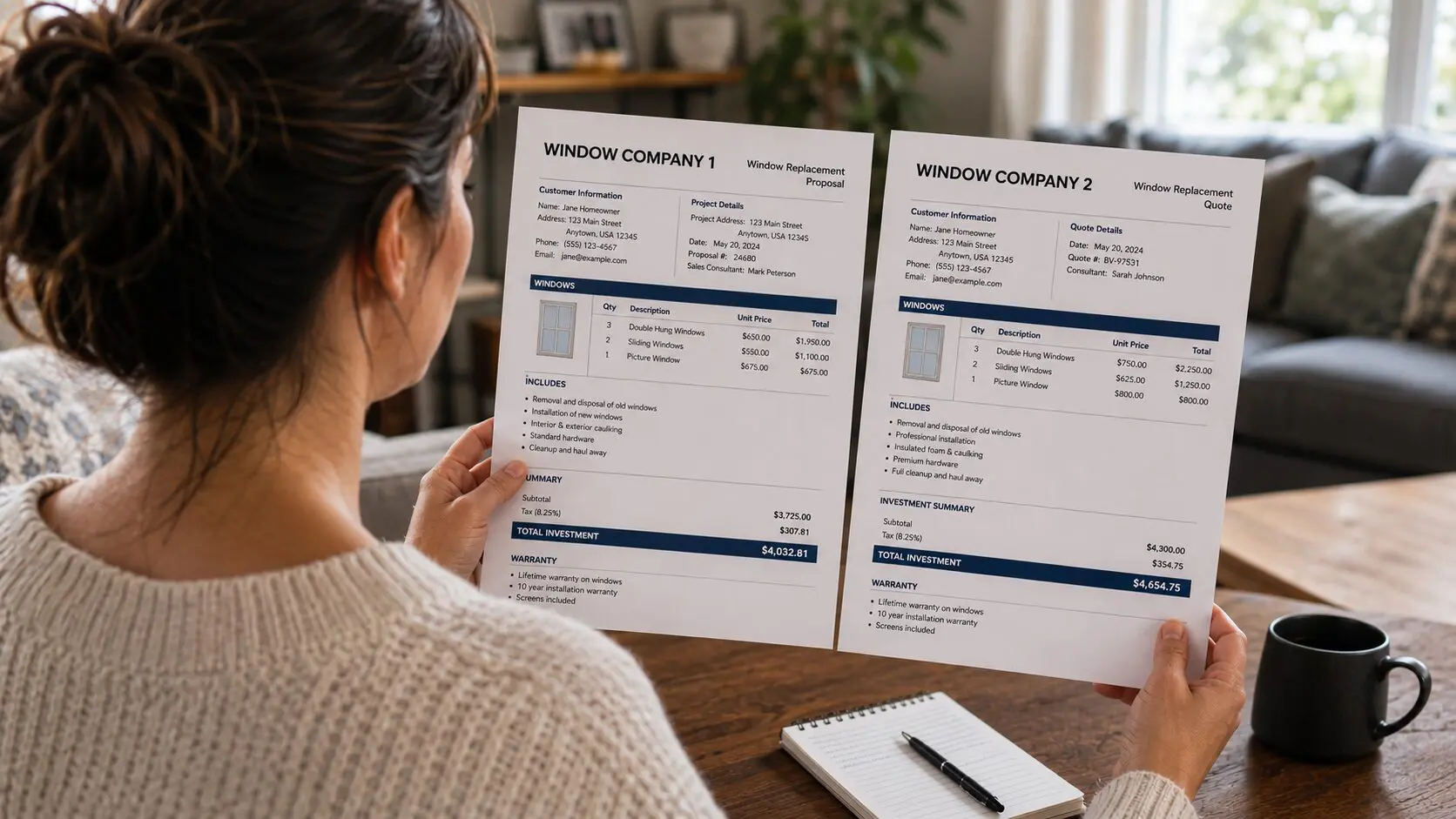
For example, you can upload your quotes and ask ChatGPT to create a side-by-side comparison of the products, installation scope, warranties, included work, exclusions, and pricing. This can make it easier to spot differences that aren’t obvious from looking at the total price alone.
Just remember that AI can only evaluate the information included in the proposals. It can’t tell you whether a contractor will do quality work or whether something important was left out of every quote.
If you’d like to try it, read How to Use ChatGPT to Compare Window Replacement Quotes for prompts you can use and what to look for in the results.
Should You Tell Window Companies You’re Getting Other Bids?
Yes, if it comes up. But pay more attention to how the company responds than to whether you disclose it.
A reputable window contractor should be comfortable with you researching your options and getting another estimate if you need one. If a salesperson pressures you to sign before meeting with another company, discourages you from comparing quotes, or makes a special price contingent on buying that day, treat that as a red flag.
This type of pressure is common in the home improvement industry’s one-call close sales model. The goal is to get a homeowner to make a decision during the first appointment, before they have an opportunity to compare the price, product, or scope with another contractor.
That doesn’t mean you have to get another bid. If you’ve done your research, like the company, understand the proposal, and feel comfortable moving forward, you can.
The important difference is that you should be the one deciding you don’t need another quote, not the salesperson deciding for you.
How Far Apart Should You Schedule Window Estimates?
Try to get your estimates during roughly the same decision-making period.
If you receive one quote in January and another six months later, price changes can make the comparison less useful.
Eric noted that material and labor pricing can change throughout the year. If you’re planning a project for next year, online pricing tools and published ranges may be better for early budgeting.
Once you’re realistically prepared to move forward within the next month or two, that’s when exact in-home estimates become more useful.
And if you’ve already scheduled five appointments but feel confident after number two, it’s okay to cancel the remaining appointments.
You’re not obligated to sit through another sales presentation because it’s already on your calendar.
How Do You Know When You Have Enough Window Quotes?
At some point, another estimate stops giving you useful information and simply gives you another option to consider.
You may have enough quotes when you can confidently answer four questions:
- Do I understand what I’m buying?
- Do I understand how it will be installed and what is included?
- Am I comfortable with the price and warranty?
- Do I trust the company to complete the project and stand behind its work?
If the answer to all four is yes, ask yourself one final question:
What am I hoping another bid will tell me?
If you can name something specific—a second opinion on installation, confirmation that the price is reasonable, or another product to compare—another estimate may be worthwhile.
If you can’t identify anything you still need to learn, you may already have enough information to make your decision.
So, How Many Window Bids Should You Get in 2026?
The traditional three-bid rule isn’t necessarily wrong. It’s just no longer the only way to make an informed decision.
With the amount of information available to homeowners today, you can do much of the initial comparison before scheduling an appointment. Research the companies, understand the type of contractor you’re looking for, learn about their products, and then invite the strongest candidate (or candidates) to your home.
If the first company checks the boxes and you feel confident in the product, installation, warranty, price, and people you’re hiring, you don’t need another bid simply to reach three. If something doesn’t add up, keep looking.
Your goal isn’t to collect a certain number of quotes. It’s to gather enough information to confidently choose who you want working on your home.
Once you know how many companies you want to consider, your next decision is which window contractors are actually qualified enough to make that list.
Read How to Tell if a Window Contractor Is Actually Qualified next. It walks you through what to look for beyond reviews and years in business, including a contractor’s actual window experience, installation practices, service structure, and warranty support. By the end, you’ll be better equipped to decide which companies are worth inviting to your home for a quote and which ones you can eliminate before scheduling an appointment.
And if Allied Exteriors is one of the companies you’re considering for replacement windows in Houston, Dallas-Fort Worth, or Austin, your next step is to schedule an honest in-home estimate with one of our consultants.
Frequently Asked Questions About Getting Window Bids
Should I always get three quotes for replacement windows?
No. Three quotes can be helpful, but there is no rule that says you need exactly three. If you’ve thoroughly researched a contractor and the first estimate gives you confidence in the product, installation, warranty, company, and price, you may not gain much from another appointment. If you still have unanswered questions or concerns, continue getting quotes until you have enough information to make a confident decision.
Is it okay to get only one window quote?
Yes, particularly if you’ve already done significant research or have previously worked with a contractor you trust. Eric noted that homeowners can now investigate reputation, products, reviews, and even ballpark pricing before an appointment. The in-home estimate can then confirm the remaining details, particularly the installation approach, exact project scope, and price.
How far apart should I schedule window estimates?
If you plan to compare multiple quotes, try to schedule them relatively close together and when you’re actually prepared to move forward with the project. Eric recommends seeking specific pricing when you’re realistically considering buying within the next month or two because material and labor costs can change throughout the year.
Should I tell a window contractor I’m getting other quotes?
You can, but you don’t have to. Eric explained that some companies use established pricing while others negotiate, so mentioning competing bids can affect the conversation differently depending on the contractor. More importantly, pay attention to how the representative responds. A contractor should be able to explain its own value without relying on criticizing the other companies you’re considering.
Can I cancel my remaining window estimates if I already found a contractor I like?
Absolutely. If you’ve scheduled several estimates but find a contractor you’re comfortable hiring before completing them all, you aren’t obligated to keep the remaining appointments just to reach a certain number of bids. Eric specifically recommends canceling or rescheduling if you’ve already found the right company or are becoming overwhelmed by too many appointments.
Allied Exteriors Blog
Whether you’re comparing replacement windows, researching siding materials, or trying to understand project costs, our Learning Center is built to help you make informed decisions before talking with a contractor.